This interesting article is about a Survival instructor trying to create the ultimate survival shotgun.
For this project, I decided to build a survival kit using a shotgun platform–creating the Ultimate Survival Shotgun. My challenge was that everything had to be included in or on the gun itself–no extra pack items or containers. Below is what I did as well as the survival logic behind each decision.
Ultimately your survival needs fall into five main categories. Your situation dictates the order. They are:
Water
Fire
Shelter
Signaling
Food
Every survival kit must include contents that directly or indirectly meet these five basic survival needs. The shotgun platform I decided to use is the Mossberg 500 – PUMP. I chose a pump action because it is easier for me to troubleshoot and work on in the field compared to other models. I chose the Mossberg brand because it is a very popular gun, and there are literally hundreds of aftermarket modification pieces and parts designed to fit this gun. I knew I would want to add on some of these extras to increase the gun’s survival value.
Visit the link for pictures and step by step info.
Showing posts with label weapons. Show all posts
Showing posts with label weapons. Show all posts
The XM-25 Individual Airburst Weapon

 The XM-25 Individual Airburst Weapon is the kind of gun that you see in movies such as Fifth Element or Judge Dredd, but never expect to be real. Well, it certainly is real, and it's now ready to be tested in combat.
The gun fires a 25-millimeter "smart round" that can be detonated at pre-programmed distance, spreading shrapnel in all directions. It uses a rangefinder to figure out how far away a target is, and the operator can manually adjust when the bullet detonates to suit different situations, allowing a soldier to attack entrenched targets around corners and in buildings more effectively.
Check out the video below to hear an officer at the Aberdeen Test Center in Maryland lay down a scenario in which the XM-25 could be a real game changer.

Koosh Bullets
I'm a little hesitant to shoot toys at an intruder only to have them return fire with adult bullets. I'll stick with my .45, I think.
Lightfield has been selling these projectiles to law enforcement agencies and wildlife officials for years. Each round is filled with a soft projectile that resembles a koosh ball. They look like toys, because they're made by a Chinese toy factory. The best thing about them is that they aren't likely to kill someone even if they are fired at point blank range. They're so soft that they're almost incapable of penetrating the body.

Learn more about Koosh bullets.
Lightfield has been selling these projectiles to law enforcement agencies and wildlife officials for years. Each round is filled with a soft projectile that resembles a koosh ball. They look like toys, because they're made by a Chinese toy factory. The best thing about them is that they aren't likely to kill someone even if they are fired at point blank range. They're so soft that they're almost incapable of penetrating the body.

Learn more about Koosh bullets.
They Picked the Wrong Man to Rob
I recieved this by e-mail, and have not yet found it's source to corroberate the story. This may be Mexico City, not El Paso.


Living on the border, we are all familiar with criminals coming from Mexican
gangs. In this situation three armed felons crossed the US border, and tried to
rob an off duty El Paso, Texas Police Officer dressed in civilian clothes while
he stood in front of a bank. The plan was for two of them to grab his backpack
and toss it to an accomplice on a stolen motorcycle. However, the well prepared
Police Officer shot all of them, managing to kill 2 immediately. The 3rd one was
shot in both arms and bleed to death before help arrived. Gun used: a 40 cal.


Bill and Buck Pattillo - WWII Veterans Reunited with their Warbirds
Two P-51 pilots reunite with their warbirds

Most times when you look forward to a big event that is years in the making and is the culmination of a tremendous amount of time work, it can be a big letdown. This was not the case at Oshkosh this year. The airshow and our time with these two WWII legends far exceeded even my wildest dreams. They were AWESOME. Funny, lively, and absolute gentleman. When people speak of the Greatest Generation, I now know what they mean. It is Bill and Buck Pattillo they are referring to. These men are warriors and patriots, and it was a special honor to meet them and spend so much time in their company.
I could write a novel about the stories they told (Bill being shot down in Sweet and Lovely, the POW marches he was led on, Buck bailing out of airplanes on fire, his engine flaming out on takeoff in a plane loaded with napalm, the formation of the Thunderbirds demonstration team, and on and on...) but I'll just get right to a few pictures.
This is the moment Buck Pattillo saw his Little Rebel for the first time in 64 years. The last time he stood next to his P-51 was in England in 1945.

When he arrived at the airplane, a silence came over the crowd and everyone backed away to give him time and space. He was very quiet, and at first would touch just the wing and the drop tank. I have my back to the camera in that red shirt. I encouraged Buck to stand up next to the nose of his airplane and touch it. He did that, and when he turned back to face the crowd, the cameras and flash bulbs came alive. It was a special moment.

We gave Buck his space, and he slowly made his way around the Mustang. "This is my airplane," he said softly. "This is just how she looked."

Buck is in the middle, I am at the left. The airplane's owner/builder/pilot is at the right. The emotion on Buck's face is apparent.

As we worked around the airplane to the other side, I opened up the gun bay for Buck to peer inside. He placed his hands inside and touched one of the Browning .50 caliber machine guns. Once again, it was a very poignant moment.
"Now these aren't live are they?" he asked.
"No, they won't fire," I said. "We didn't want any funny business between you two brothers when we took you flying."
"Good," he responded with a hearty laugh. "Sweet and Lovely is a beautiful airplane. I'd hate to shoot it down."

The next few pictures need some set up. What we did was re-create a 65-year old photograph. This picture, featuring the Pattillo brothers was taken in Bodney , England in 1944.

65 years later, we found the old, original pilot gear and re-staged the scene. The crowd around the airplane as we set this up was incredible.

These guys were 20 years old flying around in England during WWII. They had wild fun then, and they continue to have fun today.

Here is a shot of Bill Pattillo in front of his WWII mount, Sweet and Lovely.

The two Generals together.

Bill on the left with his Sweet and Lovely hat, Buck on the right with his Little Rebel hat:


After the initial rush died down, we asked Buck to sign his name to the rudder:

Two years ago, when Bill saw Sweet and Lovely for the very first time, he also signed his rudder:

587,000 people attended Oshkosh this year, but these guys seemed to be the center of attention. It was like hanging out with rock stars.

On Saturday, the two airplanes and the brothers were featured in the "Warbirds in Review" program. We pushed the planes up on the stage and a standing room only crowd flooded in to hear the pilots speak.


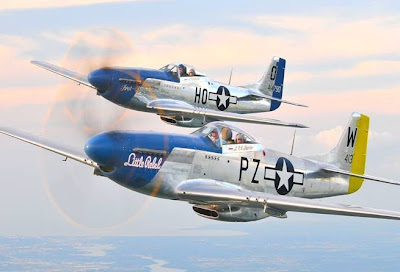
The best part of the week was Friday night. We put each brother in the back seat of his own airplane and took them flying.
I think this flight turned the clock back 20 years in their lives. Their excitement and ear-to-ear grins were second in size only to mine. In the full-resolution version of these pictures, you can easily read the thrill on their faces.
Some more on the Pattillo brothers:
Maj. Gen. Cuthbert A. "Bill" Pattillo - Pilot
487th Fighter Squadron, 352nd Fighter Group
United States Air Force Thunderbird #3
A Distinguished Veteran
Cuthbert "Bill" Pattillo and his twin brother, Charles, were born seven minutes apart on June 3, 1924, in Atlanta, Georgia. He graduated from Atlanta Technical High School in 1942, and enlisted in the U.S. Army Air Corps in November, 1942 as an aviation cadet. After receiving training in the P-40 Warhawk (specifications), he received his pilot wings and commission as a second lieutenant at Marianna, Florida, in March, 1944. He went to the European Theater and was assigned to the 487th Fighter Squadron, 352nd Fighter Group, the famous "Bluenosed Bastards of Bodney". He flew 35 combat missions in the P-51D Mustang (specifications ), (HO-Y), number 44-11556, which he called "Sweet and Lovely". He shot down an ME-262 on April 10, 1945. On April 16, 1945, he destroyed six and damaged one enemy aircraft on the ground while strafing an airdrome near Straubing, Germany, and was later shot down by ground flak. He crashed landed in a farmer's plowed field, and became a POW until the end of the war. He was released from active duty in December, 1945, and he and his brother enrolled as engineering students at the Georgia Institute of Technology. While attending school, he participated in the Reserve Military Program as a flight commander of the 54th Fighter Wing of the Georgia National Guard, flying the P-47 Thunderbolt.

'Bill' Pattillo with brother 'Buck' Pattillo
Air Demonstration Teams:
In February, 1948, he was recalled to active duty as a P-51 pilot, and was assigned to the 31st Fighter Group in Albany, Georgia. He was assigned with his brother as P-80 pilots to the 36th Fighter Group, Furstenfeldbruck, Germany, and while there, he and his brother assisted in organizing and flying with the USAF Europe Aerial Demonstration Team, the "Skyblazers", flying the P-80 and F-84. In October, 1952, he was assigned to Pinecastle Air Force Base, Florida, as a fighter gunnery instructor with the 3542nd Flying Training Squadron. In March, 1953, he was assigned to Luke Air Force Base, Arizona, as a fighter gunnery instructor along with his brother Charles.
They helped organize the original United States Air Force Aerial Demonstration Team, the "Thunderbirds." He flew right wing while his brother flew left wing.
Further Education and War
From July, 1956 to August, 1959, he first served as a tactical fighter squadron commander with the 366th Tactical Fighter Wing, and then with the 401st Tactical Fighter Wing, at England Air Force Base, Louisiana. In September, 1959, he entered the University of Colorado, and after earning a degree in mathematics, he joined the 4450th Standardization and Evaluation Group in Langley, Virginia. After completing his assignment to the Army War College in 1965, he was promoted to Colonel and assigned to the Headquarters Seventeenth Air Force, Ramstein, Germany. Upon this assignment, he and his twin brother were separated for the first time in over 23 years of military service. In March, 1967, he was assigned as Commander to the 36th Tactical Fighter Wing at Bitburg, Germany, flying the F-4 Phantom II. In March, 1968, as Vice Commander of the 8th Tactical Fighter Wing, he went to Ubon Royal Thai Air Force Base, Thailand, and became the Commanding Officer of the wing in July, 1968. He flew 120 combat missions over Vietnam in the F-4. In 1969, he was promoted to Brigadier General and was Vice Commander of the Oklahoma City Material Area at Tinker Air Force Base. In November, 1971, he became deputy director for logistics, J-4, Organization of the Joint Chiefs of Staff, Washington, D.C. In September, 1973, he became Commander of the Lowry Technical Training Center at Lowry Air Force Base, Colorado, and then Vice Commander in Chief, Pacific Air Forces. On March 1, 1979, he was promoted to Lt. General, and was the Deputy Commander in Chief, U.S. Readiness Command at MacDill Air Force Base. He retired from active duty in 1981.
Medals and Awards
Lt. General Pattillo was awarded the Distinguished Flying Cross with oak leaf cluster, Air Medal with 10 oak leaf clusters, Department of Defense Distinguished Service Medal with one Bronze Service Star (BSS), Air Force Distinguished Service Medal with oak leaf cluster, Legion of Merit with three oak leaf clusters, Army Commendation Medal, Distinguished Unit Citation emblem with oak leaf cluster, Republic of Vietnam Campaign Medal, Republic of Vietnam Air Force Distinguished Service Order 2nd Class, French Croix de Guerre with palm, and Air Force pilot wings – Nicaragua – Brazil – China – Peru.
More on "Sweet and Lovely:"
http://www.mustangsmustangs.com/p-51/survivors/pages/44-73279.shtml

Most times when you look forward to a big event that is years in the making and is the culmination of a tremendous amount of time work, it can be a big letdown. This was not the case at Oshkosh this year. The airshow and our time with these two WWII legends far exceeded even my wildest dreams. They were AWESOME. Funny, lively, and absolute gentleman. When people speak of the Greatest Generation, I now know what they mean. It is Bill and Buck Pattillo they are referring to. These men are warriors and patriots, and it was a special honor to meet them and spend so much time in their company.
I could write a novel about the stories they told (Bill being shot down in Sweet and Lovely, the POW marches he was led on, Buck bailing out of airplanes on fire, his engine flaming out on takeoff in a plane loaded with napalm, the formation of the Thunderbirds demonstration team, and on and on...) but I'll just get right to a few pictures.
This is the moment Buck Pattillo saw his Little Rebel for the first time in 64 years. The last time he stood next to his P-51 was in England in 1945.

When he arrived at the airplane, a silence came over the crowd and everyone backed away to give him time and space. He was very quiet, and at first would touch just the wing and the drop tank. I have my back to the camera in that red shirt. I encouraged Buck to stand up next to the nose of his airplane and touch it. He did that, and when he turned back to face the crowd, the cameras and flash bulbs came alive. It was a special moment.

We gave Buck his space, and he slowly made his way around the Mustang. "This is my airplane," he said softly. "This is just how she looked."

Buck is in the middle, I am at the left. The airplane's owner/builder/pilot is at the right. The emotion on Buck's face is apparent.

As we worked around the airplane to the other side, I opened up the gun bay for Buck to peer inside. He placed his hands inside and touched one of the Browning .50 caliber machine guns. Once again, it was a very poignant moment.
"Now these aren't live are they?" he asked.
"No, they won't fire," I said. "We didn't want any funny business between you two brothers when we took you flying."
"Good," he responded with a hearty laugh. "Sweet and Lovely is a beautiful airplane. I'd hate to shoot it down."

The next few pictures need some set up. What we did was re-create a 65-year old photograph. This picture, featuring the Pattillo brothers was taken in Bodney , England in 1944.

65 years later, we found the old, original pilot gear and re-staged the scene. The crowd around the airplane as we set this up was incredible.

These guys were 20 years old flying around in England during WWII. They had wild fun then, and they continue to have fun today.

Here is a shot of Bill Pattillo in front of his WWII mount, Sweet and Lovely.

The two Generals together.

Bill on the left with his Sweet and Lovely hat, Buck on the right with his Little Rebel hat:


After the initial rush died down, we asked Buck to sign his name to the rudder:

Two years ago, when Bill saw Sweet and Lovely for the very first time, he also signed his rudder:

587,000 people attended Oshkosh this year, but these guys seemed to be the center of attention. It was like hanging out with rock stars.

On Saturday, the two airplanes and the brothers were featured in the "Warbirds in Review" program. We pushed the planes up on the stage and a standing room only crowd flooded in to hear the pilots speak.


The best part of the week was Friday night. We put each brother in the back seat of his own airplane and took them flying.
I think this flight turned the clock back 20 years in their lives. Their excitement and ear-to-ear grins were second in size only to mine. In the full-resolution version of these pictures, you can easily read the thrill on their faces.
Some more on the Pattillo brothers:
Maj. Gen. Cuthbert A. "Bill" Pattillo - Pilot
487th Fighter Squadron, 352nd Fighter Group
United States Air Force Thunderbird #3
A Distinguished Veteran
Cuthbert "Bill" Pattillo and his twin brother, Charles, were born seven minutes apart on June 3, 1924, in Atlanta, Georgia. He graduated from Atlanta Technical High School in 1942, and enlisted in the U.S. Army Air Corps in November, 1942 as an aviation cadet. After receiving training in the P-40 Warhawk (specifications

'Bill' Pattillo with brother 'Buck' Pattillo
Air Demonstration Teams:
In February, 1948, he was recalled to active duty as a P-51 pilot, and was assigned to the 31st Fighter Group in Albany, Georgia. He was assigned with his brother as P-80 pilots to the 36th Fighter Group, Furstenfeldbruck, Germany, and while there, he and his brother assisted in organizing and flying with the USAF Europe Aerial Demonstration Team, the "Skyblazers", flying the P-80 and F-84. In October, 1952, he was assigned to Pinecastle Air Force Base, Florida, as a fighter gunnery instructor with the 3542nd Flying Training Squadron. In March, 1953, he was assigned to Luke Air Force Base, Arizona, as a fighter gunnery instructor along with his brother Charles.
They helped organize the original United States Air Force Aerial Demonstration Team, the "Thunderbirds." He flew right wing while his brother flew left wing.
Further Education and War
From July, 1956 to August, 1959, he first served as a tactical fighter squadron commander with the 366th Tactical Fighter Wing, and then with the 401st Tactical Fighter Wing, at England Air Force Base, Louisiana. In September, 1959, he entered the University of Colorado, and after earning a degree in mathematics, he joined the 4450th Standardization and Evaluation Group in Langley, Virginia. After completing his assignment to the Army War College in 1965, he was promoted to Colonel and assigned to the Headquarters Seventeenth Air Force, Ramstein, Germany. Upon this assignment, he and his twin brother were separated for the first time in over 23 years of military service. In March, 1967, he was assigned as Commander to the 36th Tactical Fighter Wing at Bitburg, Germany, flying the F-4 Phantom II. In March, 1968, as Vice Commander of the 8th Tactical Fighter Wing, he went to Ubon Royal Thai Air Force Base, Thailand, and became the Commanding Officer of the wing in July, 1968. He flew 120 combat missions over Vietnam in the F-4. In 1969, he was promoted to Brigadier General and was Vice Commander of the Oklahoma City Material Area at Tinker Air Force Base. In November, 1971, he became deputy director for logistics, J-4, Organization of the Joint Chiefs of Staff, Washington, D.C. In September, 1973, he became Commander of the Lowry Technical Training Center at Lowry Air Force Base, Colorado, and then Vice Commander in Chief, Pacific Air Forces. On March 1, 1979, he was promoted to Lt. General, and was the Deputy Commander in Chief, U.S. Readiness Command at MacDill Air Force Base. He retired from active duty in 1981.
Medals and Awards
Lt. General Pattillo was awarded the Distinguished Flying Cross with oak leaf cluster, Air Medal with 10 oak leaf clusters, Department of Defense Distinguished Service Medal with one Bronze Service Star (BSS), Air Force Distinguished Service Medal with oak leaf cluster, Legion of Merit with three oak leaf clusters, Army Commendation Medal, Distinguished Unit Citation emblem with oak leaf cluster, Republic of Vietnam Campaign Medal, Republic of Vietnam Air Force Distinguished Service Order 2nd Class, French Croix de Guerre with palm, and Air Force pilot wings – Nicaragua – Brazil – China – Peru.
More on "Sweet and Lovely:"
http://www.mustangsmustangs.com/p-51/survivors/pages/44-73279.shtml
Girl's Face vs. Gun
Guess who wins?
If it's not working, you can watch it here: http://www.stupidvideos.com/video/just_plain_stupid/Painful_Recoil/
If it's not working, you can watch it here: http://www.stupidvideos.com/video/just_plain_stupid/Painful_Recoil/
I Like my Hi-Point 9mm

Those pants are a lot more baggy than I realized... Anyway, the Hi-Point fired very well. I put 50 rounds through it, and it jammed once, thanks to the new clip. After a few shots, I tweaked the site, and it was dead on after that. It has a little bit of a kick, but not bad at all. Over all, I am very pleased with this gun.
In case you missed it, I wrote about my purchase a few weeks ago, the post can be found here.
Video of Bullets Hitting Various Objects in Slow-Mo
A 10-minute video showing the impact of bullets on various targets at 1 million frames per second. It was made by German engineer Werner Mehl who created the PVM-21 infrared chronograph, in many respects the most sophisticated ballistic speed-measuring system.
Via
Via
I Bought Myself a Hi-Point 9mm
I decided a wanted a new gun, but I didn't have much money to spend. I did a little research, and came across the Hi-Point 9mm. I came across some mixed reviews. There were those that said it jammed, was super ugly, and way too heavy. But, then there were those that said it was more accurate than most of the guns they owned, couldn't be easier to clean and maintain, and best of all, it came with a lifetime warranty, not questions asked, and it's made in the good old USA. Wait, I lied, the best part is the price, $149.
 So, I went out and got me one, it even came with a free box of bullets. I haven't fired it yet, but plan on it this weekend, so I'll let you know how it performs. Until then, I found this honest review at Bullshido.net:
So, I went out and got me one, it even came with a free box of bullets. I haven't fired it yet, but plan on it this weekend, so I'll let you know how it performs. Until then, I found this honest review at Bullshido.net:ACTION TYPE: Blowback SemiautoMy opinion? Glad you asked. I say, if you have been itching to get a gun, before all guns are banned, etc., and you don't have a lot of pocket change, you can't go wrong. This gun is super reliable, comes with a lifetime warranty, and is super cheap.
CALIBER: 9mm
CAPACITY: 8+1
BARREL LENGTH: 3.5"
OVERALL LENGTH: 6.75"
WEIGHT: 30 ounces
FINISH: Matte Black
SIGHTS: Adjustable, 3-Dot
GRIPS: Black Plastic
PRICE: $168
THE GOOD-
Price-This gun is uber-inexpensive. For the price of 4 boxes of .357, you can have this weapon. It also shoots cheap, readily available 9mm luger.
Consistency- Once you dial the adjustable sights in, this weapon will put a bullet in the same spot over and over again. I freely admit I never expected that from this piece. Even after several hundred rounds, this thing will shoot point of aim dead on at any distance. It has been such a treat to see a low-cost product perform this well.
Simplicity- This is a single-action-only, straight-blowback, striker-fired handgun. There are no complex mechanisms at all. It has about 8 moving parts and that’s it. Cleaning can be done without stripping; as a matter of fact, hi-point recommends you do NOT disassemble this weapon. Spray it out with cleaner, run a brush through the bore, and wipe down the feed ramp and you’re done. Seriously; it’s like having an automatic revolver.
No Worries- Warrantee is 100% no-questions-asked, fully transferable, and legendarily fast. If the weapon fails for any reason, send it back. They will fix it or give you a new one. According to anecdotes, they don’t even care how it broke. I have spoken with several owners of these, and turnaround time seems to be about 2 weeks.
THE BAD-
Picky Eater- Since the action is straight blowback, the breach does not tip back to align with the feed ramp, and the feed ramp suffers from poor polishing. The result is a weapon that will not feed non-jacketed ammo. So those super-cheap reloads that you got for $.03 a round? Don’t even try. It’s embarrassing. Even low-power jacketed ammo can be problematic. While straight-blowback is inherently simple, it necessitates a heavy slide and recoil spring, and if you have an anemic round, it may fail to throw the slide all the way back, and cause the weapon to feed the next round improperly. Half an hour with a Dremel tool will polish the feed ramp to the point that many of the feeding problems will disappear, and is not the sort of thing that requires a skilled gunsmith. That being said, both Federal and Remington 9mm Luger FMJ feed reliably and consistently right out of the box.
So shoot decent ammo! The weapon is +p rated, and using jacketed +p ammo completely eliminates this issue.
Weight- 9mm handguns should be thin and light. This one is not. Fully loaded, this beast weighs almost as much as my .357. It boasts unloaded weights of 30 oz., while competitors are fully 1/3 lighter with better ammo capacity. It has a polymer frame, but its design necessitates a big, heavy slide to operate reliably. You definitely have a BIG, HEAVY slide to deal with. The only plus to this is that with 9mm, the weight makes recoil non-existent, even with the hottest loads around.
No Staying Power- Stock single-stack magazines hold 8 rounds, and the big one holds 10. Springfield XD-9 has a 20-round stick and is lighter. Enough said.
THE UGLY-
[Only registered and activated users can see links. ]
Not even professional photography can make this thing look cool.
This Gun!- This is the second-ugliest handgun ever produced (Glock wins the prize for me. Hideous weapons!). The giant slide is milled from a single chunk of metal, has the graceful curves and angles of a Ford Edsel, and the aesthetic appeal of grandma’s meatloaf after her second bottle of tawny port. Absolutely NO consideration went into this weapon’s appearance. Well…I ain’t exactly pretty myself, so I don’t give it too much consideration.
One look!?!? ONE LOOK!?!?!- (Zoolander reference, people!) There are no accessories out there for this gun. Don’t like the polymer grips? Tough. Want to get a different recoil spring? Too bad. Conversion kits? You must be joking.
You buy this gun, you get this gun. This is not a weapon for personal expression or match-modding. It just isn’t going to happen. A Hogue hand-all rubber slide on grip sized for Glocks will go a long way toward keeping this thing in your hands after things get sweaty. As a ten dollar investment, I highly recommend it.
Snobbery- People will give you a hard time for having this gun. They will cite feeding problems and tell (anecdotal) horror stories of catastrophic failures at critical moments. If this weapon jams or fails, the problem is almost ALWAYS cheap ammo or an old magazine. Unless they can prove that this weapon is more prone to failure under normal conditions than any other, tell them to shut up. At my last trip to the range I was perfectly happy to out shoot my antagonist and his custom 1911 with this little monster.
THE REALITY-
This gun will do the job. There are many advantages to a higher-priced weapon, but there is no over-arching reason to overlook this piece if you do not have a lot to spend. Simplicity, affordability, and customer service are the strengths of this particular weapon, and as such should be considered when looking at higher-priced models. With a little patience and some common sense, this is a reliable, accurate, and well-made weapon. I have carried it cocked and locked for self-defense, and have never worried about it. If you have a little money, a little common sense, and some patience, this weapon will give you many years of excellent service at the range or for self-protection.
Don’t let anyone tell you otherwise.
Iran Reveals Second Uranium Enrichment Plant
Are we supposed to be surprised by this?
Visit msnbc.com for Breaking News, World News, and News about the Economy
Washington Post: President Obama and the leaders of France and Britain on Friday blasted Iran's construction of a previously unknown uranium enrichment facility and demanded that Tehran immediately fulfill its obligations under international law or risk the imposition of harsh new sanctions. "Iran is breaking rules that all nations must follow," Obama said, detailing how the facility at Qom had been under construction for years without being disclosed, as required, to the International Atomic Energy Association. "International law is not an empty promise." British Prime Minister Gordon Brown accused Iran of "serial deception" that he said "will shock and anger the whole international community, and it will harden our resolve."Via
Guy Blows His Thumb Off by Holding His Revolver Improperly
I came across this the other day, it isn't my account, but the account of an unfortunate gun owner. You can point to snopes, and say this isn't true, but in an episode of MythBusters, they proved it was plausible:
460XVR blew my thumb off today!
No joke, about 1/2 of my left thumb is gone ... what's left is a friggin mess.
It's pretty hard to type, and I'm only posting because you never know, it might save somebody else a thumb. I was using a 2-handed grip, fired off a Cor-Bon DPX .460 and the blast came violently out the side of the gun.
At first my thumb was so covered in blood that I couldn't see how bad it was ... and I was full of adrenaline and felt no pain. And honestly it looked really bad, my whole hand was covered in blood and it was kinda gushing.
The blown-off thumb was on my support hand. I'll re-create the grip tomorrow to see where my thumb was, but it's not like I didn't already know not to get any body part near the cylinder gap. And even if I totally screwed up and did, taking my thumb clean off seems a bit excessive?
Just be careful with those 460's. That case operates at such high pressure, it's just asking for trouble.
BTW, I bought my 460 new and had exactly 12 rounds through it. Info about the gun, it's a full-size 460 with the 8 3/4' barrel and factory installed compensator. It's one of the Whitetails Unlimited models. Ammo was 200gr Cor-Bon DPX.
The gun only had 12 or 13 rounds of the Cor-Bon through it, and 10 ..45 Long Colt rounds through it. So it was essentially still brand new.
Saw a hand specialist while there today. Lots of ways to try and save what's left, but first I just have to hope it doesn't get infected in the next few days ... then surgery early next week.
The hand specialist I spent a few hours with last night said that in gunshot wounds there is always a lot more damage than is first visible ... same with things like fireworks going off in your hand. A lot more flesh around the wound is dead, and will rot and fall off over the next couple days. That's why it's so important to keep clean, and that's also why they can't do surgery now. If they wrapped new skin over dead skin it would just puss out, possibly turn gang-green, and they'd have to start all over again.
This is an example of how he was holding his revolver. Wrong, wrong, wrong!

This is what's left of his thumb.


(Source)
460XVR blew my thumb off today!
No joke, about 1/2 of my left thumb is gone ... what's left is a friggin mess.
It's pretty hard to type, and I'm only posting because you never know, it might save somebody else a thumb. I was using a 2-handed grip, fired off a Cor-Bon DPX .460 and the blast came violently out the side of the gun.
At first my thumb was so covered in blood that I couldn't see how bad it was ... and I was full of adrenaline and felt no pain. And honestly it looked really bad, my whole hand was covered in blood and it was kinda gushing.
The blown-off thumb was on my support hand. I'll re-create the grip tomorrow to see where my thumb was, but it's not like I didn't already know not to get any body part near the cylinder gap. And even if I totally screwed up and did, taking my thumb clean off seems a bit excessive?
Just be careful with those 460's. That case operates at such high pressure, it's just asking for trouble.
BTW, I bought my 460 new and had exactly 12 rounds through it. Info about the gun, it's a full-size 460 with the 8 3/4' barrel and factory installed compensator. It's one of the Whitetails Unlimited models. Ammo was 200gr Cor-Bon DPX.
The gun only had 12 or 13 rounds of the Cor-Bon through it, and 10 ..45 Long Colt rounds through it. So it was essentially still brand new.
Saw a hand specialist while there today. Lots of ways to try and save what's left, but first I just have to hope it doesn't get infected in the next few days ... then surgery early next week.
The hand specialist I spent a few hours with last night said that in gunshot wounds there is always a lot more damage than is first visible ... same with things like fireworks going off in your hand. A lot more flesh around the wound is dead, and will rot and fall off over the next couple days. That's why it's so important to keep clean, and that's also why they can't do surgery now. If they wrapped new skin over dead skin it would just puss out, possibly turn gang-green, and they'd have to start all over again.
This is an example of how he was holding his revolver. Wrong, wrong, wrong!

This is what's left of his thumb.


(Source)
Future Weapon - Electomagnetic Warfare
Imagine the future – a strange new weapon is detonated high over a large city. There is no explosion, no visible destruction, but everything electronic within the range of this weapon will go out … permanently.
Every electronic gadget in every home and office – disabled. No computers, no T.V., no life support systems in hospitals, no water supply, no heat, no lights – truly, a return to the dark ages. Imagine a full range of new weapons; one can take out the electricity in your city, another can destroy you.
If you haven’t heard about these weapons, it’s no surprise. Their development has been secretive and they sound more like science fiction than reality. When did this reality really begin and how far advanced is it now?
This revealing documentary opens the window on this -until now- secretive science.
Watch this video
Via
Every electronic gadget in every home and office – disabled. No computers, no T.V., no life support systems in hospitals, no water supply, no heat, no lights – truly, a return to the dark ages. Imagine a full range of new weapons; one can take out the electricity in your city, another can destroy you.
If you haven’t heard about these weapons, it’s no surprise. Their development has been secretive and they sound more like science fiction than reality. When did this reality really begin and how far advanced is it now?
This revealing documentary opens the window on this -until now- secretive science.
Watch this video
Via
Tour of Duty: Face to Face Battle Between US Soldier David Bellavia and Insurgents
Starting at about 5:00 the video talks about US Soldier, David Bellavia. His story is incredible. This guy is such a freakin stud, and a real credit to the US military, and all the brave men and women that serve.
Major engagement - In Basra, a 9 man 2 vehicle patrol by 1RHA is trapped in a house by Iraqi insurgents, and resists attack in close quarters. They are eventually extracted by Warrior tracked armoured vehicles of the The Tigers with no casualties, although one of the extraction force is killed.
Minor engagement - US Marine David Bellavia fights hand to hand with an insurgent in a building in Falluja
Briefing - SA80 assault rifle, urban fighting, snap shooting.
Major engagement - In Basra, a 9 man 2 vehicle patrol by 1RHA is trapped in a house by Iraqi insurgents, and resists attack in close quarters. They are eventually extracted by Warrior tracked armoured vehicles of the The Tigers with no casualties, although one of the extraction force is killed.
Minor engagement - US Marine David Bellavia fights hand to hand with an insurgent in a building in Falluja
Briefing - SA80 assault rifle, urban fighting, snap shooting.
New Military Robot Can Feed Off Dead Bodies - Attack of the Zombie Robots!!!
Fox News:
Also, I guess there is that whole ethical thing about the robot defiling human bodies. Also, what about eating our own soldiers? How will these things differentiate between stringy, nasty terrorist flesh, and sweet, corn fed American muscle?
• Click here for a brief description of EATR at the Robotic Technology Web site.
• Click here for a much longer overview of the project in PDF format.
It could be a combination of 19th-century mechanics, 21st-century technology — and a 20th-century horror movie.Do I think this is super freaking awesome? Of course I do. But does my nerdy sci-fi mind start conjuring images of renegade, brain eating, killer robots? Absolutely. What if these things go all Chuck Norris on us, and just start killing everyone, and eating our delicious innards?
A Maryland company under contract to the Pentagon is working on a steam-powered robot that would fuel itself by gobbling up whatever organic material it can find — grass, wood, old furniture, even dead bodies.
Robotic Technology Inc.'s Energetically Autonomous Tactical Robot — that's right, "EATR" — "can find, ingest, and extract energy from biomass in the environment (and other organically-based energy sources), as well as use conventional and alternative fuels (such as gasoline, heavy fuel, kerosene, diesel, propane, coal, cooking oil, and solar) when suitable," reads the company's Web site.
That "biomass" and "other organically-based energy sources" wouldn't necessarily be limited to plant material — animal and human corpses contain plenty of energy, and they'd be plentiful in a war zone.
Also, I guess there is that whole ethical thing about the robot defiling human bodies. Also, what about eating our own soldiers? How will these things differentiate between stringy, nasty terrorist flesh, and sweet, corn fed American muscle?
• Click here for a brief description of EATR at the Robotic Technology Web site.
• Click here for a much longer overview of the project in PDF format.


Grenade Variants
Ever wish you had one of those sting grenades when you saw a big gathering of hippies at a protest, drum circle, love in, etc? I know I have. I mean, you don't want to hurt anyone, just leave some nice welts on their unwashed hippy skin.
Grenade varients:
 Fragmentation
The fragmentation grenade (commonly known as a "frag") is an anti-personnel weapon that is designed to disperse shrapnel upon exploding. The body is made of hard plastic or steel. Flechettes, notched wire, ball bearings or the case itself provide the fragments. When the word "grenade" is used without specification, and context does not suggest otherwise, it is generally assumed to refer to a fragmentation grenade.
These grenades were sometimes classed as defensive grenades because the effective casualty radius of some matched or exceeded the distance they could be thrown, thus necessitating them being thrown from behind cover. The Mills bomb or F1 grenade are examples of defensive grenades where the 30–45 m casualty radius matched or exceeded the 30 m that a grenade could reasonably be thrown.
Modern fragmentation grenades such as the United States M67 grenade have a wounding radius of 15 m (half that of older style grenades which may still be encountered) and can be thrown about 40 m. Fragments may travel more than 200 m.
 Concussion
This section does not cite any references or sources. Please help improve this article by adding citations to reliable sources. Unverifiable material may be challenged and removed. (June 2009)
The concussion grenade is an anti-personnel device that is designed to damage its target with explosive power alone. Compared to fragmentation grenades, the explosive filler is usually of a greater weight and volume. The case is far thinner and is designed to fragment as little as possible. The overpressure produced by this grenade when used in enclosed areas is greater than that produced by the fragmentation grenade. Therefore, it is especially effective in enclosed areas.
These grenades are usually classed as offensive weapons because the effective casualty radius is smaller than the distance it can be thrown.
The US MK3A2 concussion grenade is filled with TNT and has a body made of tarred cardboard.
The term 'concussion' is often erroneously applied to stun grenades. This is not descriptive of the effects caused by the grenade. The term 'concussion' is used because the grenade relies on its explosive power to create casualties.
 Percussion
This section does not cite any references or sources. Please help improve this article by adding citations to reliable sources. Unverifiable material may be challenged and removed. (June 2009)
French F1 grenade with a percussion fuze.A percussion grenade detonates upon impact with the target. Classic examples of percussion grenades are the British Gammon bomb and No. 69 grenade. Timed fuse grenades are generally preferred to hand-thrown percussion grenades because their fuzing mechanisms are safer and more robust than those used in percussion grenades. Some percussion grenades have a conventional pyrotechnic fuse fitted as a backup detonation device.
 Smoke
Smoke
This section does not cite any references or sources. Please help improve this article by adding citations to reliable sources. Unverifiable material may be challenged and removed. (June 2009)
Smoke grenadeSmoke grenades are used as ground-to-ground or ground-to-air signaling devices, target or landing zone marking devices, and screening devices for unit movement. The body is a sheet-steel cylinder with emission holes in the top and bottom. These allow the smoke to be released when the grenade is ignited. Two main types exist, colored smoke (for signaling) and screening smoke. In colored smoke grenades, the filler consists of 250 to 350 grams of colored smoke mixture (mostly potassium chlorate, lactose and a dye). Screening smoke grenades usually contain HC (hexachloroethane/zinc) smoke mixture or TA (terephthalic acid) smoke mixture. HC smoke is harmful to breathe, since it contains hydrochloric acid. Whilst not intended as a primary effect, these grenades can generate enough heat to scald or burn unprotected skin and the spent casing should not be touched until it has cooled.
 Riot control
This section does not cite any references or sources. Please help improve this article by adding citations to reliable sources. Unverifiable material may be challenged and removed. (June 2009)
CS gas grenadeTear gas grenades are similar to smoke grenades in terms of shape and operation. In tear gas grenades the filler is generally 80 to 120 grams of CS gas combined with a pyrotechnic composition which burns to generate an aerosol of CS-laden smoke. This causes extreme irritation to the eyes and, if inhaled, to the nose and throat. (See also the Branch Davidian siege). Occasionally CR gas is used instead of CS.
 Incendiary
This section does not cite any references or sources. Please help improve this article by adding citations to reliable sources. Unverifiable material may be challenged and removed. (June 2009)
Incendiary grenadeIncendiary grenades produce intense heat by means of a chemical reaction. The body is practically the same as that of a smoke grenade. The filler is 600 to 800 grams of thermate, which is an improved version of World War II-era thermite. The chemical reaction that produces the heat is called a "thermite reaction". In this reaction, powdered aluminium metal and iron oxide react to produce a stream of molten iron and aluminium oxide. This reaction produces a tremendous amount of heat, burning at 2200 °C (4000 °F). This makes incendiary grenades useful for destroying weapons caches, artillery, and vehicles. Other advantages include its ability to function without an external oxygen source, allowing it to burn underwater. Because they are not intended to be thrown, thermate incendiary grenades generally have a shorter delay fuse than other grenades e.g. two seconds.
White phosphorus (also used in smoke grenades; see above) can also be used as an incendiary agent. It burns at a temperature of 2800 °C (5000 °F). White phosphorus was notably used in the No. 76 Special Incendiary Grenade by the British Home Guard during World War II.
Thermite and white phosphorus cause some of the worst and most painful burn injuries because they burn so quickly and at such a high temperature. In addition, white phosphorus is very poisonous: a dose of 50-100 milligrams is lethal to the average human.
A common improvised incendiary grenade is the Molotov cocktail.
 Stun
Stun
This section does not cite any references or sources. Please help improve this article by adding citations to reliable sources. Unverifiable material may be challenged and removed. (June 2009)
M84 stun grenadeA stun grenade is a nonlethal weapon, similar in many respects to a true grenade. It is also called a flashbang grenade, thunderflash, a bang grenade, or a Flash and Noise Diversionary Device (FNDD). The first devices of this type were created in the 1960s at the behest of the British Special Air Service as an incapacitant.
Stun grenades are used to confuse, disorient, or distract a potential threat. A stun grenade can seriously degrade the combat effectiveness of affected personnel for up to a minute. One example is the M84 stun grenade, which produces a blinding (6-8 million Candela) flash and deafening (170-180 dB SPL) blast. This grenade can be used to incapacitate people, generally without causing serious injury.
IDF stun grenadeThe flash of light momentarily activates all photosensitive cells in the retina, making vision impossible for approximately five seconds until the eye restores the retina to its original, unstimulated state. Subjects affected by flashbangs describe seeing a single frame for the five seconds (as if their vision was "paused") until it fades and normal sight returns (some video games that simulate combat; typically the first person shooter genre, include this effect). This is because the sensory cells which have been activated continue sending the same information to the brain until they are restored to their resting state, and the brain translates this continuous information into the same image. The incredibly loud blast emitted by the grenade contributes to its incapacitating properties by disturbing the fluid in the semicircular canals of the ear.
When detonated, the fuse/grenade body assembly remains intact and produces no fragmentation. The body is a steel hexagonal tube with holes along the sides which allow a blast of light and sound to be emitted. This is done to prevent injury from shrapnel but it is still possible to receive a burn, and injuries resulting from the concussive properties of the detonation sometimes occur, the intense heat created by the flashbang can also ignite flammable materials such as fuel or certain fabrics. The fires that occurred during the Iranian Embassy Siege in London were caused by stun grenades. The filler consists of about 4.5 grams of a pyrotechnic metal-oxidant mix of magnesium or aluminium and an oxidizer such as ammonium perchlorate or potassium perchlorate.
 Sting
Sting
Sting grenades are based on the design of the fragmentation grenade. Instead of using a metal casing to produce shrapnel, they are made using two spheres of hard rubber. Inside the smaller sphere is the explosive charge, primer, and detonator. The space between the two spheres is then filled with many small, hard rubber balls. Upon detonation, the subject is incapacitated by the blunt force of the projectiles. The subject is incapacitated, winded, or at the very least dislodged from cover.
Some types have an additional payload of chemical agents like CS gas.
Sting grenades are sometimes called "stinger grenades", which is a genericized trademark as "Stinger" is trademarked by Defense Technology for its own line of sting grenades.
Impact stun
Blank Firing GrenadeA more recent development is the Blank Firing Grenade (BFIG or Blank Firing Impact Grenade). Preferred in many situations, especially training, for two main reasons; they are re-usable - and therefore more economical - because the charge is a standard ammunition blank, and they are subject to very few transport restrictions when unloaded. The BFIG contains a mechanism to fire a blank cartridge when dropped at any angle onto a hard surface from a height of a metre or more. Firing will occur in any combination of positions only on impact.
 Anti-tank
The first anti-tank grenades were improvised devices usually made by putting a number of fragmentation grenades into a sandbag or by tying them together. Due to their weight, these were normally thrown from very close range or directly placed in vulnerable spots onto an enemy vehicle.
Purpose-designed anti-tank grenades invariably use the shaped charge principle to penetrate the tank's armor. This means that the grenade has to hit the vehicle at an exact right angle for the effect to work properly. This is achieved by the grenade deploying a small drogue parachute or fabric streamers after being thrown.
Britain put the first anti-tank grenade into the field during the Second World War with the rifle-fired No 68 AT Grenade. Also developed by the UK during the war, was the No 74 ST Grenade popularly known as a sticky bomb; the main charge was held in a sphere covered in adhesive. In anticipation of a German invasion, it was produced in substantial numbers. Inherently dangerous for the user, it was relegated to Home Guard use.
During World War II, when tanks overran entrenchments, anti-tank mines could be and were used by infantry as improvised hand grenades by placing or throwing them in the path of a tank in the hope of disabling a track.
The most widely-distributed anti-tank grenades are the Russian designs of the 1950s and later, mainly the RKG-3.
Due to improvements in modern tank armor, anti-tank hand grenades are generally considered obsolete. However, in the recent Iraq War, the RKG-3 anti-tank hand grenade has made a reappearance in the service of insurgents who utilize them primarily against US Humvees, which lack the heavier armor of tanks.
Links:
RUAG - manufacturer of modern hand grenades
Mecar - Belgian manufacturer of various grenade types
Pakistan Ordnance Factories - licensed manufacturer of Arges grenades
Film of exploding grenade - taken using ultra high-speed photographic technique (2/3 million frames per second)
How Grenades Work - from HowStuffWorks
CenturioLight c/o Centurio Products Group - manufacturer of the electronic flashbang's "BAD"
Exploded view of a modern Arges 73 hand grenade
90th Infantry Division Preservation Group Article on authentic WW2 pineapple grenades
Grenade information and facts
Grenade varients:
 Fragmentation
The fragmentation grenade (commonly known as a "frag") is an anti-personnel weapon that is designed to disperse shrapnel upon exploding. The body is made of hard plastic or steel. Flechettes, notched wire, ball bearings or the case itself provide the fragments. When the word "grenade" is used without specification, and context does not suggest otherwise, it is generally assumed to refer to a fragmentation grenade.
These grenades were sometimes classed as defensive grenades because the effective casualty radius of some matched or exceeded the distance they could be thrown, thus necessitating them being thrown from behind cover. The Mills bomb or F1 grenade are examples of defensive
 grenades where the 30–45 m casualty radius matched or exceeded the 30 m that a grenade could reasonably be thrown.
Modern fragmentation grenades such as the United States M67 grenade have a wounding radius of 15 m (half that of older style grenades which may still be encountered) and can be thrown about 40 m. Fragments may travel more than 200 m.
 Concussion
This section does not cite any references or sources. Please help improve this article by adding citations to reliable sources. Unverifiable material may be challenged and removed. (June 2009)
The concussion grenade is an anti-personnel device that is designed to damage its target with explosive power alone. Compared to fragmentation grenades, the explosive filler is usually of a greater weight and volume. The case is far thinner and is designed to fragment as little as possible. The overpressure produced by this grenade when used in enclosed areas is greater than that produced by the fragmentation grenade. Therefore, it is especially effective in enclosed areas.
These grenades are usually classed as offensive weapons because the effective casualty radius is smaller than the distance it can be thrown.
The US MK3A2 concussion grenade is filled with TNT and has a body made of tarred cardboard.
The term 'concussion' is often erroneously applied to stun grenades. This is not descriptive of the effects caused by the grenade. The term 'concussion' is used because the grenade relies on its explosive power to create casualties.
 Percussion
This section does not cite any references or sources. Please help improve this article by adding citations to reliable sources. Unverifiable material may be challenged and removed. (June 2009)
French F1 grenade with a percussion fuze.A percussion grenade detonates upon impact with the target. Classic examples of percussion grenades are the British Gammon bomb and No. 69 grenade. Timed fuse grenades are generally preferred to hand-thrown percussion grenades because their fuzing mechanisms are safer and more robust than those used in percussion grenades. Some percussion grenades have a conventional pyrotechnic fuse fitted as a backup detonation device.
 Smoke
SmokeThis section does not cite any references or sources. Please help improve this article by adding citations to reliable sources. Unverifiable material may be challenged and removed. (June 2009)
Smoke grenadeSmoke grenades are used as ground-to-ground or ground-to-air signaling devices, target or landing zone marking devices, and screening devices for unit movement. The body is a sheet-steel cylinder with emission holes in the top and bottom. These allow the smoke to be released when the grenade is ignited. Two main types exist, colored smoke (for signaling) and screening smoke. In colored smoke grenades, the filler consists of 250 to 350 grams of colored smoke mixture (mostly potassium chlorate, lactose and a dye). Screening smoke grenades usually contain HC (hexachloroethane/zinc) smoke mixture or TA (terephthalic acid) smoke mixture. HC smoke is harmful to breathe, since it contains hydrochloric acid. Whilst not intended as a primary effect, these grenades can generate enough heat to scald or burn unprotected skin and the spent casing should not be touched until it has cooled.
 Riot control
This section does not cite any references or sources. Please help improve this article by adding citations to reliable sources. Unverifiable material may be challenged and removed. (June 2009)
CS gas grenadeTear gas grenades are similar to smoke grenades in terms of shape and operation. In tear gas grenades the filler is generally 80 to 120 grams of CS gas combined with a pyrotechnic composition which burns to generate an aerosol of CS-laden smoke. This causes extreme irritation to the eyes and, if inhaled, to the nose and throat. (See also the Branch Davidian siege). Occasionally CR gas is used instead of CS.
 Incendiary
This section does not cite any references or sources. Please help improve this article by adding citations to reliable sources. Unverifiable material may be challenged and removed. (June 2009)
Incendiary grenadeIncendiary grenades produce intense heat by means of a chemical reaction. The body is practically the same as that of a smoke grenade. The filler is 600 to 800 grams of thermate, which is an improved version of World War II-era thermite. The chemical reaction that produces the heat is called a "thermite reaction". In this reaction, powdered aluminium metal and iron oxide react to produce a stream of molten iron and aluminium oxide. This reaction produces a tremendous amount of heat, burning at 2200 °C (4000 °F). This makes incendiary grenades useful for destroying weapons caches, artillery, and vehicles. Other advantages include its ability to function without an external oxygen source, allowing it to burn underwater. Because they are not intended to be thrown, thermate incendiary grenades generally have a shorter delay fuse than other grenades e.g. two seconds.
White phosphorus (also used in smoke grenades; see above) can also be used as an incendiary agent. It burns at a temperature of 2800 °C (5000 °F). White phosphorus was notably used in the No. 76 Special Incendiary Grenade by the British Home Guard during World War II.
Thermite and white phosphorus cause some of the worst and most painful burn injuries because they burn so quickly and at such a high temperature. In addition, white phosphorus is very poisonous: a dose of 50-100 milligrams is lethal to the average human.
A common improvised incendiary grenade is the Molotov cocktail.
 Stun
StunThis section does not cite any references or sources. Please help improve this article by adding citations to reliable sources. Unverifiable material may be challenged and removed. (June 2009)
M84 stun grenadeA stun grenade is a nonlethal weapon, similar in many respects to a true grenade. It is also called a flashbang grenade, thunderflash, a bang grenade, or a Flash and Noise Diversionary Device (FNDD). The first devices of this type were created in the 1960s at the behest of the British Special Air Service as an incapacitant.
Stun grenades are used to confuse, disorient, or distract a potential threat. A stun grenade can seriously degrade the combat effectiveness of affected personnel for up to a minute. One example is the M84 stun grenade, which produces a blinding (6-8 million Candela) flash and deafening (170-180 dB SPL) blast. This grenade can be used to incapacitate people, generally without causing serious injury.
IDF stun grenadeThe flash of light momentarily activates all photosensitive cells in the retina, making vision impossible for approximately five seconds until the eye restores the retina to its original, unstimulated state. Subjects affected by flashbangs describe seeing a single frame for the five seconds (as if their vision was "paused") until it fades and normal sight returns (some video games that simulate combat; typically the first person shooter genre, include this effect). This is because the sensory cells which have been activated continue sending the same information to the brain until they are restored to their resting state, and the brain translates this continuous information into the same image. The incredibly loud blast emitted by the grenade contributes to its incapacitating properties by disturbing the fluid in the semicircular canals of the ear.
When detonated, the fuse/grenade body assembly remains intact and produces no fragmentation. The body is a steel hexagonal tube with holes along the sides which allow a blast of light and sound to be emitted. This is done to prevent injury from shrapnel but it is still possible to receive a burn, and injuries resulting from the concussive properties of the detonation sometimes occur, the intense heat created by the flashbang can also ignite flammable materials such as fuel or certain fabrics. The fires that occurred during the Iranian Embassy Siege in London were caused by stun grenades. The filler consists of about 4.5 grams of a pyrotechnic metal-oxidant mix of magnesium or aluminium and an oxidizer such as ammonium perchlorate or potassium perchlorate.
 Sting
StingSting grenades are based on the design of the fragmentation grenade. Instead of using a metal casing to produce shrapnel, they are made using two spheres of hard rubber. Inside the smaller sphere is the explosive charge, primer, and detonator. The space between the two spheres is then filled with many small, hard rubber balls. Upon detonation, the subject is incapacitated by the blunt force of the projectiles. The subject is incapacitated, winded, or at the very least dislodged from cover.
Some types have an additional payload of chemical agents like CS gas.
Sting grenades are sometimes called "stinger grenades", which is a genericized trademark as "Stinger" is trademarked by Defense Technology for its own line of sting grenades.
Impact stun
Blank Firing GrenadeA more recent development is the Blank Firing Grenade (BFIG or Blank Firing Impact Grenade). Preferred in many situations, especially training, for two main reasons; they are re-usable - and therefore more economical - because the charge is a standard ammunition blank, and they are subject to very few transport restrictions when unloaded. The BFIG contains a mechanism to fire a blank cartridge when dropped at any angle onto a hard surface from a height of a metre or more. Firing will occur in any combination of positions only on impact.
 Anti-tank
The first anti-tank grenades were improvised devices usually made by putting a number of fragmentation grenades into a sandbag or by tying them together. Due to their weight, these were normally thrown from very close range or directly placed in vulnerable spots onto an enemy vehicle.
Purpose-designed anti-tank grenades invariably use the shaped charge principle to penetrate the tank's armor. This means that the grenade has to hit the vehicle at an exact right angle for the effect to work properly. This is achieved by the grenade deploying a small drogue parachute or fabric streamers after being thrown.
Britain put the first anti-tank grenade into the field during the Second World War with the rifle-fired No 68 AT Grenade. Also developed by the UK during the war, was the No 74 ST Grenade popularly known as a sticky bomb; the main charge was held in a sphere covered in adhesive. In anticipation of a German invasion, it was produced in substantial numbers. Inherently dangerous for the user, it was relegated to Home Guard use.
During World War II, when tanks overran entrenchments, anti-tank mines could be and were used by infantry as improvised hand grenades by placing or throwing them in the path of a tank in the hope of disabling a track.
The most widely-distributed anti-tank grenades are the Russian designs of the 1950s and later, mainly the RKG-3.
Due to improvements in modern tank armor, anti-tank hand grenades are generally considered obsolete. However, in the recent Iraq War, the RKG-3 anti-tank hand grenade has made a reappearance in the service of insurgents who utilize them primarily against US Humvees, which lack the heavier armor of tanks.
Links:
RUAG - manufacturer of modern hand grenades
Mecar - Belgian manufacturer of various grenade types
Pakistan Ordnance Factories - licensed manufacturer of Arges grenades
Film of exploding grenade - taken using ultra high-speed photographic technique (2/3 million frames per second)
How Grenades Work - from HowStuffWorks
CenturioLight c/o Centurio Products Group - manufacturer of the electronic flashbang's "BAD"
Exploded view of a modern Arges 73 hand grenade
90th Infantry Division Preservation Group Article on authentic WW2 pineapple grenades
Grenade information and facts

Taser Deaths Concerning
 |  |  |
| Written by epublius | |
| Sunday, 21 June 2009 14:33 | |
|
Recently a 32-year-old Utah man died from being Tasered [1]. This man was having a mental breakdown and his wife called the police for help. The officer that responded apparently felt the Taser was his only method of getting the situation under control. This decision has killed a man, left his wife a widow, and has two children without a father. The damage to his family will last a lifetime.
I fully recognize that law enforcement has a difficult job and has to often deal with dangerous people and situations. With that said the procedures that are being taught to these officers needs to be reviewed.
Attempting to research this issue, I was unable to determine how many people have died as a result of being Tasered. The New York Daily Record [2] reported in February this year the following.
“A recent research study, conducted by Dr. William P. Bozeman of Wake Forest University Baptist Medical Center in Winston-Salem, N.C., looked at more than 1,200 cases of Taser use from six police departments across the country from 2005 to 2008.
In those cases, Bozeman found that an overwhelming majority of the people shocked did not suffer serious injuries.
In contrast, Amnesty International's latest report on Tasers, titled, "USA: Less Than Lethal?" links 334 deaths to Taser use between the years 2001 and 2008.”
I must first note that the information referred to in the Wake Forest study in this article is incorrect.
The two-year study (2005-2007) conducted by Wake Forest University Baptist Medical Center [3] only involved 962 subjects and only 2 deaths were reported, but they were determined not to be related to the use of the Taser. The problem with this study is there are too many variables to rely on this data. With an increasing number of police departments using these devices in more and more situations, the outcome has changed.
Recently, a 72-year-old grandmother was Tasered during a traffic stop. In this case, video showed that she was difficult and uncooperative, however the officer chose to Taser her instead of physically subduing the women. After Tasering the women, the officer demanded her to put her hands behind her back which she was clearly unable to do.
The belief seems to be that attempting to physically apprehend a suspect could cause injury. Therefore, Tasering is viewed as a safer alternative. This logic is wrong. Tasers can kill. Injuries like broken bones will heal.
Ultimately, use of Tasers is playing “Russian Roulette” with peoples lives. The United States Justice Department report on Tasers states, “There is no medical evidence to suggest that exposure to a Conductive Energy Device produces sufficient metabolic or physiologic effects to produce abnormal cardiac rhythms in normal, healthy adults [4].” The report goes on to give contributing factors, which could exist in anyone and result in their death. Even the report from Wakefield stated the devices are not risk free.
I think that the problem we are facing is two-fold. Law enforcement agencies have the belief that Tasers are safer alternative to physical confrontations. Therefore, they are being used in many more situations, even in situations where it is not warranted.
I also suspect that police departments are using this technology instead of spending money on proper training. The case of the 72-year-old grandmother is a great example. A properly trained officer should have been able to handle this woman without resorting to a Taser.
They sell the Taser as a less- lethal weapon, but it still can be lethal. If officers used their gun to wound people in different situations and only a few died, there would be a public outrage.
Tasers certainly have their place, but they should not be used as a cheaper alternative to training. I think training is extremely important both in the art of physical confrontation, and in the use of Tasers. Only when there is a legitimate threat is using a Taser justified. Responding to an unarmed naked man who is having a mental breakdown on a Utah highway is not. Please Visit E-Publius Post
|


