The following are 35 shocking statistics that prove that things have gotten worse in America….
#1 Median household income in the United States is down 7.8 percent since December 2007 after adjusting for inflation.
#2 There are 5.6 million less jobs than there were when the last recession began back in late 2007.
#3 The U.S. government says that the number of Americans “not in the labor force” rose by 17.9 million between 2000 and 2011. During the entire decade of the 1980s, the number of Americans “not in the labor force” rose by only 1.7 million.
#4 In 2007, the unemployment rate for the 20 to 29 age bracket was about 6.5 percent. Today, the unemployment rate for that same age group is about 13 percent.
#5 In 2007, 73.2 percent of all young adults between the ages of 18 and 24 that were not enrolled in school had jobs. Today, that number has declined to 65 percent.
#6 Back in the year 2000, more than 50 percent of all Americans teens had a job. This past summer, only 29.6% of all American teens had a job.
#7 When Barack Obama entered the White House, the number of “long-term unemployed workers” in the United States was approximately 2.6 million. Today, that number is sitting at 5.6 million.
#8 The average duration of unemployment in the United States is nearly three times as long as it was back in the year 2000.
#9 Back in 1950, more than 80 percent of all men in the United States had jobs. Today, less than 65 percent of all men in the United States have jobs.
#10 According to the Obama administration, about 20 percent of all jobs in the United States were manufacturing jobs back in the year 2000. Today, about 5 percent of all jobs in the United States are manufacturing jobs.
#11 Sadly, more than 56,000 manufacturing facilities in the United States have been shut down since 2001.
#12 Back in 1980, less than 30% of all jobs in the United States were low income jobs. Today, more than 40% of all jobs in the United States are low income jobs.
#13 The U.S. trade deficit with China during 2011 was 28 times larger than it was back in 1990.
#14 About twice as many new homes were sold in the United States in 1965 as are being sold today.
#15 Home prices in the 4th quarter of 2011 were four percent lower than they were during the 4th quarter of 2010. Overall, U.S. home prices are 34 percent lower than they were back at the peak of the housing bubble.
#16 The total value of household real estate in America has declined from $22.7 trillion in 2006 to $16.2 trillion today.
#17 At the end of 2011, 22.8 percent of all homes in the United States with a mortgage were in negative equity. That would have been unthinkable a decade or two ago.
#18 Total home mortgage debt in the United States is now about 5 times larger than it was just 20 years ago.
#19 Total consumer debt in the United States has increased by a whopping 1700% since 1971.
#20 Since the beginning of 2009, the average price of a gallon of gasoline in the United States has increased by more than90 percent.
#21 The number of children living in poverty in the state of California has increased by 30 percent since 2007.
#22 Back in the year 2000, 11.3% of all Americans were living in poverty. Today, 15.1% of all Americans are living in poverty.
#23 In November 2008, 30.8 million Americans were on food stamps. Today, 46.5 million Americans are on food stamps.
#24 The U.S. dollar has lost 96.2 percent of its value since 1900. You can thank the Federal Reserve system for that.
#25 In 1950, the United States was #1 in GDP per capita. Today, the United States is #13 in GDP per capita.
#26 According to the U.S. Census Bureau, 49 percent of all Americans live in a home that receives direct monetary benefits from the federal government. Back in 1983, less than a third of all Americans lived in a home that received direct monetary benefits from the federal government.
#27 In 1980, government transfer payments accounted for just 11.7% of all income. Today, government transfer payments account for more than 18 percent of all income.
#28 Federal housing assistance increased by a whopping 42 percent between 2006 and 2010.
#29 Medicare spending increased by 138 percent between 1999 and 2010.
#30 Back in 1990, the federal government accounted for 32 percent of all health care spending in America. Today, that figure is up to 45 percent and it is projected to surpass 50 percent very shortly.
#31 Back in 1965, only one out of every 50 Americans was on Medicaid. Today, one out of every 6 Americans is on Medicaid, and things are about to get a whole lot worse. It is being projected that Obamacare will add 16 million more Americans to the Medicaid rolls.
#32 Right now, spending by the federal government accounts for about 24 percent of GDP. Back in 2001, it accounted for just 18 percent.
#33 In 2004, the U.S. government had a budget deficit of a little over 412 billion dollars. This year, the U.S. government will run a budget deficit of over 1.3 trillion dollars.
#34 In 2001, the U.S. national debt was less than 6 trillion dollars. Today, it is over 15 trillion dollars and it is increasing by about 150 million dollars every single hour.
#35 The U.S. national debt is now more than 22 times larger than it was when Jimmy Carter became president.
Showing posts with label economy. Show all posts
Showing posts with label economy. Show all posts

Obama's Jobs Plan - $250,000 Per Job

For those eager to put some math to the rhetoric coming from the White House over the president's jobs creation plan, and that should be everyone, here is a quick and dirty estimate based on the numbers being thrown around of a 2 percent GDP increase in year 1 and 1.9 million jobs created or saved...most saved, as in those you can't really quantify. Said otherwise, roughly a $300 billion increase in GDP yields 1.9 million jobs. So far so good.
Now since the president is proposing to pay for the program over 10 years, let's assume the $475 billion in direct expenses is financed for 10 years at 2.5 percent which adds roughly $120 billion to the total cost of the program. In other words, as the calculations detailed and show below elaborate, the overall AJA plan will cost $250,000 per job created (excluding the interest expense) and $312,500 per union job created (including interest). And that's how much it costs for Obama to purchase one vote...created or saved. Keynesian efficiency strikes like a Swiss watch yet again.
So that's $250,000 per job, before interest expense.
Source
Now since the president is proposing to pay for the program over 10 years, let's assume the $475 billion in direct expenses is financed for 10 years at 2.5 percent which adds roughly $120 billion to the total cost of the program. In other words, as the calculations detailed and show below elaborate, the overall AJA plan will cost $250,000 per job created (excluding the interest expense) and $312,500 per union job created (including interest). And that's how much it costs for Obama to purchase one vote...created or saved. Keynesian efficiency strikes like a Swiss watch yet again.
So that's $250,000 per job, before interest expense.
Source

Pentagon Racked $720 Million in Late Fees
Remember how the Government decided that they needed to raise the debt ceiling, because they just couldn't seem to stop hemoraging money? Well, if that made you made, this will make it worse:
The Pentagon has spent more than $720million since 2001 on fees for shipping containers that it fails to return on time, according to data and contracts obtained by USA TODAY.
The containers — large metal boxes stowed on ships and moved from port on trucks — are familiar sights on bases in Iraq and Afghanistan where troops use them for storage, shelter and building material. Yet each 20-foot container returned late can rack up more than $2,200 in late fees. Shipping companies charge the government daily "container detention fees" after the grace period ends for the box to be returned.
In case you are worried that the Pentagon is going to go bankrupt over this little oversight, don't worry, they have a budget of about $553 billion.
The Pentagon has spent more than $720million since 2001 on fees for shipping containers that it fails to return on time, according to data and contracts obtained by USA TODAY.
The containers — large metal boxes stowed on ships and moved from port on trucks — are familiar sights on bases in Iraq and Afghanistan where troops use them for storage, shelter and building material. Yet each 20-foot container returned late can rack up more than $2,200 in late fees. Shipping companies charge the government daily "container detention fees" after the grace period ends for the box to be returned.
In case you are worried that the Pentagon is going to go bankrupt over this little oversight, don't worry, they have a budget of about $553 billion.
How Much Congress Spent on Food to Stuff their Faces with
From AOL News:
The House's overall tab$2.6 million spent on food and beverages for reps and their staffers
$604K - Spent on bottled water -- in 19,000 individual line items, many for Nestle's Deer Park water-delivery subsidiary.
$397K - Spent on catering -- CapitolHost is easily the largest caterer serving the House, though there's plenty to go around here.
$135K - Spent on meals at restaurants of all shapes and sizes, including $152 at Quiznos.
$7,536 - The amount Maryland Rep. Elijah Cummings spent on catering -- more than any other legislator.
$1,316 - Average amount spent by legislators who used catering services.
$124K - Spent on Occasions Caterers, which had just three House offices as clients.
$23K - Spent on catering services by Betty Crudup.
$6K - Spent on Brown Bag Catering (which, despite its name, does not specialize in peanut butter and jelly)
$63,016 spent with Restaurant Associates.
$35,824 - The amount the Committee on Foreign Affairs spent with the firm.
$5,812 - The amount Nebraska Rep. Lee Terry spent with the firm. He's one of 13 legislators who logged an expense with Restaurant Associates.
$84,794 spent with coffee-centric companies.
7,743 Pounds of coffee beans (at $10.95 each) could be bought with that much money.
348,468 Cups of coffee (about 45 8-ounce cups per pound) could be brewed from that many beans.
$10,673 spent with barbecue restaurants
$3,649 - The amount the House's Committee on Homeland Security spent on Gates Bar-B-Q, a Kansas City, Mo., institution.
$3,901 - The amount Colorado Rep. Ed Perlmutter spent on Denver's Big Papa's BBQ, which claims to have "the best ribs in Colorado"
$37K - The amount the House spent with the Good Food Co., which specializes in day care food.
$8,786 - The amount spent on food and drink at various colleges and universities.
$1,401 - The amount Pennsylvania Rep. Joseph Pitts spent at Yoder's Country Market, in Amish country.
$209,673 - Amount spent by the Page Revolving Fund.
$140,027 - Amount that went to FreedomPay -- by far the fund's biggest expense.
Other top food-purchasing offices: In second place is the Democratic Caucus, which spent more than half of its $193,557 in food expenditures on a weekend getaway at Kingsmill Resort in Williamsburg, Va. Waaaaaaay behind that is the Office of the Speaker, which spent nearly three-quarters of its $83,341 in expenditures with Occasions Caterers.
The House Committee on Foreign Affairs spent $40,479 on food, all of it on catering. The total was five times the amount spent by the next-hungriest committee, Homeland Security.
Who's Gregorio Sablan? He's the House delegate for the Northern Mariana Islands, who spent more on food than any other legislator. In fact, Sablan spent $6,000 more than the second-place legislator, Texas Republican Michael Burgess, who spent $17,515. $23,457 - Amount of Sablan's total expenses
$5,127 - Amount spent in Sablan's name specifically.
$3,000 - Amount spent at Saipan's Hyatt Regency by Sablan staffers.
$3,000 - Amount spent with D.C. caterer CapitolHost by Sablan staffers.
Which Party Is Hungrier?
Because we wanted to compare the two parties' equivalent offices, we left the speaker out of it. The Office of the Speaker did, however, spend $83,341, most of it with one catering company. But beyond Nancy Pelosi, here's how offices common to both parties -- majority and minority leaders and whips, as well as party caucuses -- spent money on food:
$298,734 - Amount spent by the Democratic Party's largest offices -- the Democratic Caucus, the Office of the Majority Leader and the Office of the Majority Whip.
$202,927 - Amount spent by the Republican Party's largest offices -- the Republican Conference, the Office of the Minority Leader and the Office of the Minority Whip.
What Democrats bought:
Beyond the already-mentioned weekend getaway to Williamsburg, Va. (which cost $114,925), three top staffers -- two for the Democratic Caucus and one for the majority whip -- were reimbursed as individuals for $87,611. Those four items alone account for $202,536 of the total -- or nearly what the GOP's main offices spent.
Other details:
$985 - The amount Democratic leadership spent on Chantilly Donuts.
$2,362 - The amount Democratic leadership spent at Corner Bakery Cafe.
$4,543 - The amount Democratic leadership spent with Coca-Cola Enterprises.
What Republicans bought:
The bulk of GOP reps' expenses -- around $144,146 -- was spent through Citibank, so there's no itemized data. Another $34,427, however, was spent with CapitolHost, by far the largest catering company they used. Other details:
$2,076 - The amount GOP leadership spent on Chantilly Donuts.
$9,374 - The amount GOP leadership spent with coffee companies.
$4,651 - The amount GOP leadership spent with Coca-Cola Enterprises.
The House's overall tab$2.6 million spent on food and beverages for reps and their staffers
$604K - Spent on bottled water -- in 19,000 individual line items, many for Nestle's Deer Park water-delivery subsidiary.
$397K - Spent on catering -- CapitolHost is easily the largest caterer serving the House, though there's plenty to go around here.
$135K - Spent on meals at restaurants of all shapes and sizes, including $152 at Quiznos.
$7,536 - The amount Maryland Rep. Elijah Cummings spent on catering -- more than any other legislator.
$1,316 - Average amount spent by legislators who used catering services.
$124K - Spent on Occasions Caterers, which had just three House offices as clients.
$23K - Spent on catering services by Betty Crudup.
$6K - Spent on Brown Bag Catering (which, despite its name, does not specialize in peanut butter and jelly)
$63,016 spent with Restaurant Associates.
$35,824 - The amount the Committee on Foreign Affairs spent with the firm.
$5,812 - The amount Nebraska Rep. Lee Terry spent with the firm. He's one of 13 legislators who logged an expense with Restaurant Associates.
$84,794 spent with coffee-centric companies.
7,743 Pounds of coffee beans (at $10.95 each) could be bought with that much money.
348,468 Cups of coffee (about 45 8-ounce cups per pound) could be brewed from that many beans.
$10,673 spent with barbecue restaurants
$3,649 - The amount the House's Committee on Homeland Security spent on Gates Bar-B-Q, a Kansas City, Mo., institution.
$3,901 - The amount Colorado Rep. Ed Perlmutter spent on Denver's Big Papa's BBQ, which claims to have "the best ribs in Colorado"
$37K - The amount the House spent with the Good Food Co., which specializes in day care food.
$8,786 - The amount spent on food and drink at various colleges and universities.
$1,401 - The amount Pennsylvania Rep. Joseph Pitts spent at Yoder's Country Market, in Amish country.
$209,673 - Amount spent by the Page Revolving Fund.
$140,027 - Amount that went to FreedomPay -- by far the fund's biggest expense.
Other top food-purchasing offices: In second place is the Democratic Caucus, which spent more than half of its $193,557 in food expenditures on a weekend getaway at Kingsmill Resort in Williamsburg, Va. Waaaaaaay behind that is the Office of the Speaker, which spent nearly three-quarters of its $83,341 in expenditures with Occasions Caterers.
The House Committee on Foreign Affairs spent $40,479 on food, all of it on catering. The total was five times the amount spent by the next-hungriest committee, Homeland Security.
Who's Gregorio Sablan? He's the House delegate for the Northern Mariana Islands, who spent more on food than any other legislator. In fact, Sablan spent $6,000 more than the second-place legislator, Texas Republican Michael Burgess, who spent $17,515. $23,457 - Amount of Sablan's total expenses
$5,127 - Amount spent in Sablan's name specifically.
$3,000 - Amount spent at Saipan's Hyatt Regency by Sablan staffers.
$3,000 - Amount spent with D.C. caterer CapitolHost by Sablan staffers.
Which Party Is Hungrier?
Because we wanted to compare the two parties' equivalent offices, we left the speaker out of it. The Office of the Speaker did, however, spend $83,341, most of it with one catering company. But beyond Nancy Pelosi, here's how offices common to both parties -- majority and minority leaders and whips, as well as party caucuses -- spent money on food:
$298,734 - Amount spent by the Democratic Party's largest offices -- the Democratic Caucus, the Office of the Majority Leader and the Office of the Majority Whip.
$202,927 - Amount spent by the Republican Party's largest offices -- the Republican Conference, the Office of the Minority Leader and the Office of the Minority Whip.
What Democrats bought:
Beyond the already-mentioned weekend getaway to Williamsburg, Va. (which cost $114,925), three top staffers -- two for the Democratic Caucus and one for the majority whip -- were reimbursed as individuals for $87,611. Those four items alone account for $202,536 of the total -- or nearly what the GOP's main offices spent.
Other details:
$985 - The amount Democratic leadership spent on Chantilly Donuts.
$2,362 - The amount Democratic leadership spent at Corner Bakery Cafe.
$4,543 - The amount Democratic leadership spent with Coca-Cola Enterprises.
What Republicans bought:
The bulk of GOP reps' expenses -- around $144,146 -- was spent through Citibank, so there's no itemized data. Another $34,427, however, was spent with CapitolHost, by far the largest catering company they used. Other details:
$2,076 - The amount GOP leadership spent on Chantilly Donuts.
$9,374 - The amount GOP leadership spent with coffee companies.
$4,651 - The amount GOP leadership spent with Coca-Cola Enterprises.
What's Wrong with this Picture?
Are there any jobs left in America? Or have they all been shipped over seas to save a few pennies?

50 Random Facts That Make You Wonder What In The World Has Happened To America
From the Economic Collapse Blog:
Our world is changing at a pace that is so staggering these days that it can be really hard to fully grasp the significance of what we are witnessing. Hopefully the collection of random facts below will help you to "connect the dots" just a little bit. On one level, the facts below may not seem related. However, what they all do have in common is that they show just how much the United States has fundamentally changed. Do you ever just sit back and wonder what in the world has happened to America? The truth is that the America that so many of us once loved so much has been shattered into a thousand pieces. The "land of the free and the home of the brave" has been transformed into a socialized Big Brother nanny state that is oozing with corruption and has accumulated the biggest mountain of debt in the history of the world. The greatest economic machine that the world has ever seen is falling apart before our very eyes, and even when our politicians actually try to do something right (which is quite rare) the end result is still a bunch of garbage. For those who still love this land (and there are a lot of us) it is heartbreaking to watch America slowly die.
The following are 50 random facts that show just how dramatically America has changed.
#50) A new report released by the United Nations is publicly calling for the establishment of a world currency and none of the major news networks are even covering it.
#49) The state of California is so broke that Arnold Schwarzenegger has ordered California State Controller John Chiang to reduce state worker pay for July to the federal minimum allowed by law -- $7.25 an hour for most state workers.
#48) A police officer in Oklahoma recently tasered an 86-year-old disabled grandma in her bed and stepped on her oxygen hose until she couldn't breathe because they considered her to be a "threat".
#47) In early 2009, U.S. net national savings as a percentage of GDP went negative for the first time since 1952, and it has continued its downward trend since then.
#46) Corexit 9500 is so incredibly toxic that the UK's Marine Management Organization has completely banned it, so if there was a major oil spill in the North Sea, BP would not be able to use it. And yet BP has dumped over a million gallons of dispersants such as Corexit 9500 into the Gulf of Mexico.
#45) For the first time in U.S. history, more than 40 million Americans are on food stamps, and the U.S. Department of Agriculture projects that number will go up to 43 million Americans in 2011.
#44) It has come out that one employee used a Federal Emergency Management Agency credit card to buy $4,318 in "Happy Birthday" gift cards. Two other FEMA officials charged the cost of 360 golf umbrellas ($9,000) to the taxpayers.
#43) Researchers at the State University of New York at Buffalo received $389,000 from the U.S. government to pay 100 residents of Buffalo $45 each to record how much malt liquor they drink and how much pot they smoke each day.
#42) The average duration of unemployment in the United States has risen to an all-time high.
#41) The bottom 40 percent of all income earners in the United States now collectively own less than 1 percent of the nation's wealth.
#40) In the U.S., the average federal worker now earns about twice as much as the average worker in the private sector.
#39) Back in 1950 each retiree's Social Security benefit was paid for by 16 workers. Today, each retiree's Social Security benefit is paid for by approximately 3.3 workers. By 2025 it is projected that there will be approximately two workers for each retiree.
#38) According to a U.S. Treasury Department report to Congress, the U.S. national debt will top $13.6 trillion this year and climb to an estimated $19.6 trillion by 2015.
#37) The federal government actually has the gall to ask for online donations that will supposedly go towards paying off the national debt.
#36) The Cactus Bug Project at the University Of Florida was allocated $325,394 in economic stimulus funds to study the mating decisions of cactus bugs.
#35) A dinner cruise company in Chicago got nearly $1 million in economic stimulus funds to combat terrorism.
#34) It is being reported that a 6-year-old girl from Ohio is on the "no fly" list maintained by U.S. Homeland Security.
#33) During the first quarter of 2010, the total number of loans that are at least three months past due in the United States increased for the 16th consecutive quarter.
#32) According to a new report, Americans spend twice as much as residents of other developed countries on healthcare, but get lower quality and far less efficiency.
#31) Some experts are warning that the cost of bailing out Fannie Mae and Freddie Mac could reach as high as $1 trillion.
#30) The FDA has announced that the offspring of cloned animals could be in our food supply right now and that there is nothing that they can do about it.
#29) In May, sales of new homes in the United States dropped to the lowest level ever recorded.
#28) In 1950, the ratio of the average executive's paycheck to the average worker's paycheck was about 30 to 1. Since the year 2000, that ratio has ranged between 300 to 500 to one.
#27) Federal border officials recently said that Mexican drug cartels have not only set up shop on American soil, they are actually maintaining lookout bases in strategic locations in the hills of southern Arizona.
#26) The U.S. government has declared some parts of Arizona off limits to U.S. citizens because of the threat of violence from Mexican drug smugglers.
#25) According to the credit card repayment calculator, if you owe $6000 on a credit card with a 20 percent interest rate and only pay the minimum payment each time, it will take you 54 years to pay off that credit card. During those 54 years you will pay $26,168 in interest rate charges in addition to the $6000 in principal that you are required to pay back.
#24) According to prepared testimony by Goldman Sachs Chief Operating Officer Gary Cohn, Goldman Sachs shorted roughly $615 million of the collateralized debt obligations and residential mortgage-backed securities the firm underwrote since late 2006.
#23) The six biggest banks in the United States now possess assets equivalent to 60 percent of America's gross national product.
#22) Four of the biggest U.S. banks (Goldman Sachs, JPMorgan Chase, Bank of America and Citigroup) had a "perfect quarter" with zero days of trading losses during the first quarter of 2010.
#21) 1.41 million Americans filed for personal bankruptcy in 2009 - a 32 percent increase over 2008.
#20) BP has hired private security contractors to keep the American people away from oil cleanup sites and nobody seems to care.
#19) Barack Obama is calling for a "civilian expeditionary force" to be sent to Afghanistan and Iraq to help overburdened military troops build infrastructure.
#18) On June 18th, two Christians decided that they would peacefully pass out copies of the gospel of John on a public sidewalk outside a public Arab festival in Dearborn, Michigan and within 3 minutes 8 policemen surrounded them and placed them under arrest.
#17) It is being reported that sales of foreclosed homes in Florida made up nearly 40 percent of all home purchases in the first part of this year.
#16) During a recent interview with Larry King, former first lady Laura Bush revealed to the world that she is actually in favor of legalized gay marriage and a woman's "right" to abortion.
#15) Scientists at Columbia University are warning that the dose of radiation from the new full body security scanners going into airports all over the United States could be up to 20 times higher than originally estimated.
#14) 43 percent of Americans have less than $10,000 saved for retirement.
#13) The FDIC's deposit insurance fund now has negative 20.7 billion dollars in it, which represents a slight improvement from the end of 2009.
#12) The judge that BP is pushing for to hear an estimated 200 lawsuits on the Gulf of Mexico oil disaster gets tens of thousands of dollars a year in oil royalties and is paid travel expenses to industry conferences.
#11) In recent years the U.S. government has spent $2.6 million tax dollars to study the drinking habits of Chinese prostitutes and $400,000 tax dollars to pay researchers to cruise six bars in Buenos Aires, Argentina to find out why gay men engage in risky sexual behavior when drunk.
#10) U.S. officials say that more than three billion dollars in cash (much of it aid money paid for by U.S. taxpayers) has been stolen by corrupt officials in Afghanistan and flown out of Kabul International Airport in recent years.
#9) According to a report by the U.S. Department of Transportation's Bureau of Transportation Statistics, the baggage check fees collected by U.S. airlines shot up 33% in the first quarter of 2010 to $769 million.
#8) Three California high school students are fighting for their right to show their American patriotism - even on a Mexican holiday - after they were forced to remove their American flag T-shirts on Cinco de Mayo.
#7) Right now, interest on the U.S. national debt and spending on entitlement programs like Social Security and Medicare are somewhere in the neighborhood of 10 to 15 percent of GDP. By 2080, they are projected to eat up approximately 50 percent of GDP.
#6) The total of all government, corporate and consumer debt in the United States is now about 360 percent of GDP.
#5) A 6-year-old girl was recently handcuffed and sent to a mental facility after throwing temper tantrums at her elementary school.
#4) In Florida, students have been arrested by police for things as simple as bringing a plastic butter knife to school, throwing an eraser, and drawing a picture of a gun.
#3) School officials in one town in Massachusetts are refusing to allow students to recite the Pledge of Allegiance.
#2) According to one new study, approximately 21 percent of children in the United States are living below the poverty line in 2010.
#1) Since 1973, more than 50 million babies have been murdered in abortion facilities across the United States.
Source: http://theeconomiccollapseblog.com/archives/50-random-facts-that-make-you-wonder-what-in-the-world-has-happened-to-america
Our world is changing at a pace that is so staggering these days that it can be really hard to fully grasp the significance of what we are witnessing. Hopefully the collection of random facts below will help you to "connect the dots" just a little bit. On one level, the facts below may not seem related. However, what they all do have in common is that they show just how much the United States has fundamentally changed. Do you ever just sit back and wonder what in the world has happened to America? The truth is that the America that so many of us once loved so much has been shattered into a thousand pieces. The "land of the free and the home of the brave" has been transformed into a socialized Big Brother nanny state that is oozing with corruption and has accumulated the biggest mountain of debt in the history of the world. The greatest economic machine that the world has ever seen is falling apart before our very eyes, and even when our politicians actually try to do something right (which is quite rare) the end result is still a bunch of garbage. For those who still love this land (and there are a lot of us) it is heartbreaking to watch America slowly die.
The following are 50 random facts that show just how dramatically America has changed.
#50) A new report released by the United Nations is publicly calling for the establishment of a world currency and none of the major news networks are even covering it.
#49) The state of California is so broke that Arnold Schwarzenegger has ordered California State Controller John Chiang to reduce state worker pay for July to the federal minimum allowed by law -- $7.25 an hour for most state workers.
#48) A police officer in Oklahoma recently tasered an 86-year-old disabled grandma in her bed and stepped on her oxygen hose until she couldn't breathe because they considered her to be a "threat".
#47) In early 2009, U.S. net national savings as a percentage of GDP went negative for the first time since 1952, and it has continued its downward trend since then.
#46) Corexit 9500 is so incredibly toxic that the UK's Marine Management Organization has completely banned it, so if there was a major oil spill in the North Sea, BP would not be able to use it. And yet BP has dumped over a million gallons of dispersants such as Corexit 9500 into the Gulf of Mexico.
#45) For the first time in U.S. history, more than 40 million Americans are on food stamps, and the U.S. Department of Agriculture projects that number will go up to 43 million Americans in 2011.
#44) It has come out that one employee used a Federal Emergency Management Agency credit card to buy $4,318 in "Happy Birthday" gift cards. Two other FEMA officials charged the cost of 360 golf umbrellas ($9,000) to the taxpayers.
#43) Researchers at the State University of New York at Buffalo received $389,000 from the U.S. government to pay 100 residents of Buffalo $45 each to record how much malt liquor they drink and how much pot they smoke each day.
#42) The average duration of unemployment in the United States has risen to an all-time high.
#41) The bottom 40 percent of all income earners in the United States now collectively own less than 1 percent of the nation's wealth.
#40) In the U.S., the average federal worker now earns about twice as much as the average worker in the private sector.
#39) Back in 1950 each retiree's Social Security benefit was paid for by 16 workers. Today, each retiree's Social Security benefit is paid for by approximately 3.3 workers. By 2025 it is projected that there will be approximately two workers for each retiree.
#38) According to a U.S. Treasury Department report to Congress, the U.S. national debt will top $13.6 trillion this year and climb to an estimated $19.6 trillion by 2015.
#37) The federal government actually has the gall to ask for online donations that will supposedly go towards paying off the national debt.
#36) The Cactus Bug Project at the University Of Florida was allocated $325,394 in economic stimulus funds to study the mating decisions of cactus bugs.
#35) A dinner cruise company in Chicago got nearly $1 million in economic stimulus funds to combat terrorism.
#34) It is being reported that a 6-year-old girl from Ohio is on the "no fly" list maintained by U.S. Homeland Security.
#33) During the first quarter of 2010, the total number of loans that are at least three months past due in the United States increased for the 16th consecutive quarter.
#32) According to a new report, Americans spend twice as much as residents of other developed countries on healthcare, but get lower quality and far less efficiency.
#31) Some experts are warning that the cost of bailing out Fannie Mae and Freddie Mac could reach as high as $1 trillion.
#30) The FDA has announced that the offspring of cloned animals could be in our food supply right now and that there is nothing that they can do about it.
#29) In May, sales of new homes in the United States dropped to the lowest level ever recorded.
#28) In 1950, the ratio of the average executive's paycheck to the average worker's paycheck was about 30 to 1. Since the year 2000, that ratio has ranged between 300 to 500 to one.
#27) Federal border officials recently said that Mexican drug cartels have not only set up shop on American soil, they are actually maintaining lookout bases in strategic locations in the hills of southern Arizona.
#26) The U.S. government has declared some parts of Arizona off limits to U.S. citizens because of the threat of violence from Mexican drug smugglers.
#25) According to the credit card repayment calculator, if you owe $6000 on a credit card with a 20 percent interest rate and only pay the minimum payment each time, it will take you 54 years to pay off that credit card. During those 54 years you will pay $26,168 in interest rate charges in addition to the $6000 in principal that you are required to pay back.
#24) According to prepared testimony by Goldman Sachs Chief Operating Officer Gary Cohn, Goldman Sachs shorted roughly $615 million of the collateralized debt obligations and residential mortgage-backed securities the firm underwrote since late 2006.
#23) The six biggest banks in the United States now possess assets equivalent to 60 percent of America's gross national product.
#22) Four of the biggest U.S. banks (Goldman Sachs, JPMorgan Chase, Bank of America and Citigroup) had a "perfect quarter" with zero days of trading losses during the first quarter of 2010.
#21) 1.41 million Americans filed for personal bankruptcy in 2009 - a 32 percent increase over 2008.
#20) BP has hired private security contractors to keep the American people away from oil cleanup sites and nobody seems to care.
#19) Barack Obama is calling for a "civilian expeditionary force" to be sent to Afghanistan and Iraq to help overburdened military troops build infrastructure.
#18) On June 18th, two Christians decided that they would peacefully pass out copies of the gospel of John on a public sidewalk outside a public Arab festival in Dearborn, Michigan and within 3 minutes 8 policemen surrounded them and placed them under arrest.
#17) It is being reported that sales of foreclosed homes in Florida made up nearly 40 percent of all home purchases in the first part of this year.
#16) During a recent interview with Larry King, former first lady Laura Bush revealed to the world that she is actually in favor of legalized gay marriage and a woman's "right" to abortion.
#15) Scientists at Columbia University are warning that the dose of radiation from the new full body security scanners going into airports all over the United States could be up to 20 times higher than originally estimated.
#14) 43 percent of Americans have less than $10,000 saved for retirement.
#13) The FDIC's deposit insurance fund now has negative 20.7 billion dollars in it, which represents a slight improvement from the end of 2009.
#12) The judge that BP is pushing for to hear an estimated 200 lawsuits on the Gulf of Mexico oil disaster gets tens of thousands of dollars a year in oil royalties and is paid travel expenses to industry conferences.
#11) In recent years the U.S. government has spent $2.6 million tax dollars to study the drinking habits of Chinese prostitutes and $400,000 tax dollars to pay researchers to cruise six bars in Buenos Aires, Argentina to find out why gay men engage in risky sexual behavior when drunk.
#10) U.S. officials say that more than three billion dollars in cash (much of it aid money paid for by U.S. taxpayers) has been stolen by corrupt officials in Afghanistan and flown out of Kabul International Airport in recent years.
#9) According to a report by the U.S. Department of Transportation's Bureau of Transportation Statistics, the baggage check fees collected by U.S. airlines shot up 33% in the first quarter of 2010 to $769 million.
#8) Three California high school students are fighting for their right to show their American patriotism - even on a Mexican holiday - after they were forced to remove their American flag T-shirts on Cinco de Mayo.
#7) Right now, interest on the U.S. national debt and spending on entitlement programs like Social Security and Medicare are somewhere in the neighborhood of 10 to 15 percent of GDP. By 2080, they are projected to eat up approximately 50 percent of GDP.
#6) The total of all government, corporate and consumer debt in the United States is now about 360 percent of GDP.
#5) A 6-year-old girl was recently handcuffed and sent to a mental facility after throwing temper tantrums at her elementary school.
#4) In Florida, students have been arrested by police for things as simple as bringing a plastic butter knife to school, throwing an eraser, and drawing a picture of a gun.
#3) School officials in one town in Massachusetts are refusing to allow students to recite the Pledge of Allegiance.
#2) According to one new study, approximately 21 percent of children in the United States are living below the poverty line in 2010.
#1) Since 1973, more than 50 million babies have been murdered in abortion facilities across the United States.
Source: http://theeconomiccollapseblog.com/archives/50-random-facts-that-make-you-wonder-what-in-the-world-has-happened-to-america
50 Statistics About The U.S. Economy That Are Almost Too Crazy To Believe
Via The American Dream:
Most Americans know that the U.S. economy is in bad shape, but what most Americans don't know is how truly desperate the financial situation of the United States really is. The truth is that what we are experiencing is not simply a "downturn" or a "recession". What we are witnessing is the beginning of the end for the greatest economic machine that the world has ever seen. Our greed and our debt are literally eating our economy alive. Total government, corporate and personal debt has now reached 360 percent of GDP, which is far higher than it ever reached during the Great Depression era. We have nearly totally dismantled our once colossal manufacturing base, we have shipped millions upon millions of middle class jobs overseas, we have lived far beyond our means for decades and we have created the biggest debt bubble in the history of the world. A great day of financial reckoning is fast approaching, and the vast majority of Americans are totally oblivious.
But the truth is that you cannot defy the financial laws of the universe forever. What goes up must come down. The borrower is the servant of the lender. Cutting corners always catches up with you in the end.
Sometimes it takes cold, hard numbers for many of us to fully realize the situation that we are facing.
So, the following are 50 very revealing statistics about the U.S. economy that are almost too crazy to believe....
#50) In 2010 the U.S. government is projected to issue almost as much new debt as the rest of the governments of the world combined.
#49) It is being projected that the U.S. government will have a budget deficit of approximately 1.6 trillion dollars in 2010.
#48) If you went out and spent one dollar every single second, it would take you more than 31,000 years to spend a trillion dollars.
#47) In fact, if you spent one million dollars every single day since the birth of Christ, you still would not have spent one trillion dollars by now.
#46) Total U.S. government debt is now up to 90 percent of gross domestic product.
#45) Total credit market debt in the United States, including government, corporate and personal debt, has reached 360 percent of GDP.
#44) U.S. corporate income tax receipts were down 55% (to $138 billion) for the year ending September 30th, 2009.
#43) There are now 8 counties in the state of California that have unemployment rates of over 20 percent.
#42) In the area around Sacramento, California there is one closed business for every six that are still open.
#41) In February, there were 5.5 unemployed Americans for every job opening.
#40) According to a Pew Research Center study, approximately 37% of all Americans between the ages of 18 and 29 have either been unemployed or underemployed at some point during the recession.
#39) More than 40% of those employed in the United States are now working in low-wage service jobs.
#38) According to one new survey, 24% of American workers say that they have postponed their planned retirement age in the past year.
#37) Over 1.4 million Americans filed for personal bankruptcy in 2009, which represented a 32 percent increase over 2008. Not only that, more Americans filed for bankruptcy in March 2010 than during any month since U.S. bankruptcy law was tightened in October 2005.
#36) Mortgage purchase applications in the United States are down nearly 40 percent from a month ago to their lowest level since April of 1997.
#35) RealtyTrac has announced that foreclosure filings in the U.S. established an all time record for the second consecutive year in 2009.
#34) According to RealtyTrac, foreclosure filings were reported on 367,056 properties in March 2010, an increase of nearly 19 percent from February, an increase of nearly 8 percent from March 2009 and the highest monthly total since RealtyTrac began issuing its report in January 2005.
#33) In Pinellas and Pasco counties, which include St. Petersburg, Florida and the suburbs to the north, there are 34,000 open foreclosure cases. Ten years ago, there were only about 4,000.
#32) In California's Central Valley, 1 out of every 16 homes is in some phase of foreclosure.
#31) The Mortgage Bankers Association recently announced that more than 10 percent of all U.S. homeowners with a mortgage had missed at least one payment during the January to March time period. That was a record high and up from 9.1 percent a year ago.
#30) U.S. banks repossessed nearly 258,000 homes nationwide in the first quarter of 2010, a 35 percent jump from the first quarter of 2009.
#29) For the first time in U.S. history, banks own a greater share of residential housing net worth in the United States than all individual Americans put together.
#28) More than 24% of all homes with mortgages in the United States were underwater as of the end of 2009.
#27) U.S. commercial property values are down approximately 40 percent since 2007 and currently 18 percent of all office space in the United States is sitting vacant.
#26) Defaults on apartment building mortgages held by U.S. banks climbed to a record 4.6 percent in the first quarter of 2010. That was almost twice the level of a year earlier.
#25) In 2009, U.S. banks posted their sharpest decline in private lending since 1942.
#24) New York state has delayed paying bills totalling $2.5 billion as a short-term way of staying solvent but officials are warning that its cash crunch could soon get even worse.
#23) To make up for a projected 2010 budget shortfall of $280 million, Detroit issued $250 million of 20-year municipal notes in March. The bond issuance followed on the heels of a warning from Detroit officials that if its financial state didn't improve, it could be forced to declare bankruptcy.
#22) The National League of Cities says that municipal governments will probably come up between $56 billion and $83 billion short between now and 2012.
#21) Half a dozen cash-poor U.S. states have announced that they are delaying their tax refund checks.
#20) Two university professors recently calculated that the combined unfunded pension liability for all 50 U.S. states is 3.2 trillion dollars.
#19) According to EconomicPolicyJournal.com, 32 U.S. states have already run out of funds to make unemployment benefit payments and so the federal government has been supplying these states with funds so that they can make their payments to the unemployed.
#18) This most recession has erased 8 million private sector jobs in the United States.
#17) Paychecks from private business shrank to their smallest share of personal income in U.S. history during the first quarter of 2010.
#16) U.S. government-provided benefits (including Social Security, unemployment insurance, food stamps and other programs) rose to a record high during the first three months of 2010.
#15) 39.68 million Americans are now on food stamps, which represents a new all-time record. But things look like they are going to get even worse. The U.S. Department of Agriculture is forecasting that enrollment in the food stamp program will exceed 43 million Americans in 2011.
#14) Phoenix, Arizona features an astounding annual car theft rate of 57,000 vehicles and has become the new "Car Theft Capital of the World".
#13) U.S. law enforcement authorities claim that there are now over 1 million members of criminal gangs inside the country. These 1 million gang members are responsible for up to 80% of the crimes committed in the United States each year.
#12) The U.S. health care system was already facing a shortage of approximately 150,000 doctors in the next decade or so, but thanks to the health care "reform" bill passed by Congress, that number could swell by several hundred thousand more.
#11) According to an analysis by the Congressional Joint Committee on Taxation the health care "reform" bill will generate $409.2 billion in additional taxes on the American people by 2019.
#10) The Dow Jones Industrial Average just experienced the worst May it has seen since 1940.
#9) In 1950, the ratio of the average executive's paycheck to the average worker's paycheck was about 30 to 1. Since the year 2000, that ratio has exploded to between 300 to 500 to one.
#8) Approximately 40% of all retail spending currently comes from the 20% of American households that have the highest incomes.
#7) According to economists Thomas Piketty and Emmanuel Saez, two-thirds of income increases in the U.S. between 2002 and 2007 went to the wealthiest 1% of all Americans.
#6) The bottom 40 percent of income earners in the United States now collectively own less than 1 percent of the nation's wealth.
#5) If you only make the minimum payment each and every time, a $6,000 credit card bill can end up costing you over $30,000 (depending on the interest rate).
#4) According to a new report based on U.S. Census Bureau data, only 26 percent of American teens between the ages of 16 and 19 had jobs in late 2009 which represents a record low since statistics began to be kept back in 1948.
#3) According to a National Foundation for Credit Counseling survey, only 58% of those in "Generation Y" pay their monthly bills on time.
#2) During the first quarter of 2010, the total number of loans that are at least three months past due in the United States increased for the 16th consecutive quarter.
#1) According to the Tax Foundation's Microsimulation Model, to erase the 2010 U.S. budget deficit, the U.S. Congress would have to multiply each tax rate by 2.4. Thus, the 10 percent rate would be 24 percent, the 15 percent rate would be 36 percent, and the 35 percent rate would have to be 85 percent.
Most Americans know that the U.S. economy is in bad shape, but what most Americans don't know is how truly desperate the financial situation of the United States really is. The truth is that what we are experiencing is not simply a "downturn" or a "recession". What we are witnessing is the beginning of the end for the greatest economic machine that the world has ever seen. Our greed and our debt are literally eating our economy alive. Total government, corporate and personal debt has now reached 360 percent of GDP, which is far higher than it ever reached during the Great Depression era. We have nearly totally dismantled our once colossal manufacturing base, we have shipped millions upon millions of middle class jobs overseas, we have lived far beyond our means for decades and we have created the biggest debt bubble in the history of the world. A great day of financial reckoning is fast approaching, and the vast majority of Americans are totally oblivious.
But the truth is that you cannot defy the financial laws of the universe forever. What goes up must come down. The borrower is the servant of the lender. Cutting corners always catches up with you in the end.
Sometimes it takes cold, hard numbers for many of us to fully realize the situation that we are facing.
So, the following are 50 very revealing statistics about the U.S. economy that are almost too crazy to believe....
#50) In 2010 the U.S. government is projected to issue almost as much new debt as the rest of the governments of the world combined.
#49) It is being projected that the U.S. government will have a budget deficit of approximately 1.6 trillion dollars in 2010.
#48) If you went out and spent one dollar every single second, it would take you more than 31,000 years to spend a trillion dollars.
#47) In fact, if you spent one million dollars every single day since the birth of Christ, you still would not have spent one trillion dollars by now.
#46) Total U.S. government debt is now up to 90 percent of gross domestic product.
#45) Total credit market debt in the United States, including government, corporate and personal debt, has reached 360 percent of GDP.
#44) U.S. corporate income tax receipts were down 55% (to $138 billion) for the year ending September 30th, 2009.
#43) There are now 8 counties in the state of California that have unemployment rates of over 20 percent.
#42) In the area around Sacramento, California there is one closed business for every six that are still open.
#41) In February, there were 5.5 unemployed Americans for every job opening.
#40) According to a Pew Research Center study, approximately 37% of all Americans between the ages of 18 and 29 have either been unemployed or underemployed at some point during the recession.
#39) More than 40% of those employed in the United States are now working in low-wage service jobs.
#38) According to one new survey, 24% of American workers say that they have postponed their planned retirement age in the past year.
#37) Over 1.4 million Americans filed for personal bankruptcy in 2009, which represented a 32 percent increase over 2008. Not only that, more Americans filed for bankruptcy in March 2010 than during any month since U.S. bankruptcy law was tightened in October 2005.
#36) Mortgage purchase applications in the United States are down nearly 40 percent from a month ago to their lowest level since April of 1997.
#35) RealtyTrac has announced that foreclosure filings in the U.S. established an all time record for the second consecutive year in 2009.
#34) According to RealtyTrac, foreclosure filings were reported on 367,056 properties in March 2010, an increase of nearly 19 percent from February, an increase of nearly 8 percent from March 2009 and the highest monthly total since RealtyTrac began issuing its report in January 2005.
#33) In Pinellas and Pasco counties, which include St. Petersburg, Florida and the suburbs to the north, there are 34,000 open foreclosure cases. Ten years ago, there were only about 4,000.
#32) In California's Central Valley, 1 out of every 16 homes is in some phase of foreclosure.
#31) The Mortgage Bankers Association recently announced that more than 10 percent of all U.S. homeowners with a mortgage had missed at least one payment during the January to March time period. That was a record high and up from 9.1 percent a year ago.
#30) U.S. banks repossessed nearly 258,000 homes nationwide in the first quarter of 2010, a 35 percent jump from the first quarter of 2009.
#29) For the first time in U.S. history, banks own a greater share of residential housing net worth in the United States than all individual Americans put together.
#28) More than 24% of all homes with mortgages in the United States were underwater as of the end of 2009.
#27) U.S. commercial property values are down approximately 40 percent since 2007 and currently 18 percent of all office space in the United States is sitting vacant.
#26) Defaults on apartment building mortgages held by U.S. banks climbed to a record 4.6 percent in the first quarter of 2010. That was almost twice the level of a year earlier.
#25) In 2009, U.S. banks posted their sharpest decline in private lending since 1942.
#24) New York state has delayed paying bills totalling $2.5 billion as a short-term way of staying solvent but officials are warning that its cash crunch could soon get even worse.
#23) To make up for a projected 2010 budget shortfall of $280 million, Detroit issued $250 million of 20-year municipal notes in March. The bond issuance followed on the heels of a warning from Detroit officials that if its financial state didn't improve, it could be forced to declare bankruptcy.
#22) The National League of Cities says that municipal governments will probably come up between $56 billion and $83 billion short between now and 2012.
#21) Half a dozen cash-poor U.S. states have announced that they are delaying their tax refund checks.
#20) Two university professors recently calculated that the combined unfunded pension liability for all 50 U.S. states is 3.2 trillion dollars.
#19) According to EconomicPolicyJournal.com, 32 U.S. states have already run out of funds to make unemployment benefit payments and so the federal government has been supplying these states with funds so that they can make their payments to the unemployed.
#18) This most recession has erased 8 million private sector jobs in the United States.
#17) Paychecks from private business shrank to their smallest share of personal income in U.S. history during the first quarter of 2010.
#16) U.S. government-provided benefits (including Social Security, unemployment insurance, food stamps and other programs) rose to a record high during the first three months of 2010.
#15) 39.68 million Americans are now on food stamps, which represents a new all-time record. But things look like they are going to get even worse. The U.S. Department of Agriculture is forecasting that enrollment in the food stamp program will exceed 43 million Americans in 2011.
#14) Phoenix, Arizona features an astounding annual car theft rate of 57,000 vehicles and has become the new "Car Theft Capital of the World".
#13) U.S. law enforcement authorities claim that there are now over 1 million members of criminal gangs inside the country. These 1 million gang members are responsible for up to 80% of the crimes committed in the United States each year.
#12) The U.S. health care system was already facing a shortage of approximately 150,000 doctors in the next decade or so, but thanks to the health care "reform" bill passed by Congress, that number could swell by several hundred thousand more.
#11) According to an analysis by the Congressional Joint Committee on Taxation the health care "reform" bill will generate $409.2 billion in additional taxes on the American people by 2019.
#10) The Dow Jones Industrial Average just experienced the worst May it has seen since 1940.
#9) In 1950, the ratio of the average executive's paycheck to the average worker's paycheck was about 30 to 1. Since the year 2000, that ratio has exploded to between 300 to 500 to one.
#8) Approximately 40% of all retail spending currently comes from the 20% of American households that have the highest incomes.
#7) According to economists Thomas Piketty and Emmanuel Saez, two-thirds of income increases in the U.S. between 2002 and 2007 went to the wealthiest 1% of all Americans.
#6) The bottom 40 percent of income earners in the United States now collectively own less than 1 percent of the nation's wealth.
#5) If you only make the minimum payment each and every time, a $6,000 credit card bill can end up costing you over $30,000 (depending on the interest rate).
#4) According to a new report based on U.S. Census Bureau data, only 26 percent of American teens between the ages of 16 and 19 had jobs in late 2009 which represents a record low since statistics began to be kept back in 1948.
#3) According to a National Foundation for Credit Counseling survey, only 58% of those in "Generation Y" pay their monthly bills on time.
#2) During the first quarter of 2010, the total number of loans that are at least three months past due in the United States increased for the 16th consecutive quarter.
#1) According to the Tax Foundation's Microsimulation Model, to erase the 2010 U.S. budget deficit, the U.S. Congress would have to multiply each tax rate by 2.4. Thus, the 10 percent rate would be 24 percent, the 15 percent rate would be 36 percent, and the 35 percent rate would have to be 85 percent.
Several Reasons for Our Countries Money Woes
1. $11 billion to $22 billion is spent on welfare to illegal aliens each year by state governments.
Verify at: http://www.fairus.org/site/PageServer?pagename=iic_immigrationissuecenters7fd8
2. In 2002 alone, $1.9 billion dollars was spent on food assistance programs such as food stamps, WIC, and free school lunches for illegal aliens.
Verify at: http://www.cis.org/articles/2004/fiscalexec.HTML
3. In 2002 $2.5 alone, billion dollars was spent on Medicaid for illegal aliens.
Verify at: http://www.cis.org/articles/2004/fiscalexec.HTML
4. In 2006 alone, $12 billion dollars was spent on primary and secondary school education for children here illegally.
Verify at: http://transcripts.cnn.com/TRANSCRIPTS/0604/01/ldt.01.html
5. In 2006 alone, $17 billion dollars was spent for education for the American-born children of illegal aliens, known as anchor babies.
Verify at: http://transcripts.cnn.com/TRANscriptS/0604/01/ldt.01.HTML
6. In 2006 alone, $3 million dollars a day was spent to incarcerate illegal aliens.
Verify at: http://transcripts.cnn.com/%20TRANscriptS/0604/01/ldt.01.HTML
7. in 2006 alone, 30% percent of all Federal prison inmates were illegal aliens.
Verify at: http://transcripts.cnn.com/TRANscriptS/0604/01/ldt.01.HTML
8. in 2006 alone, $90 billion Dollars a year was spent on illegal aliens for Welfare & social services by the American taxpayers.
Verify at: http://premium.cnn.com/TRANSCIPTS/0610/29/ldt.01.HTML
9. In 2006 alone, $200 billion dollars a year in suppressed American wages were caused by the illegal aliens.
Verify at: http://transcripts.cnn.com/TRANSC%20RI%20PTS/0604/01/ldt.01.HTML
10. In 2006 alone, the illegal aliens in the United States had a crime rate that was two and a half times that of non-illegal aliens.
Verify at: http://transcripts.cnn/..com/TRANscriptS/0606/12/ldt..01.HTML
11. In 2006 alone, illegal aliens sent home $45 billion in remittances to their countries of origin. Verify at: http://rense.com/general75/niht.htm
;"' href="http://20w.drdsk.com/articleshtml%3E;%22" target=_blank rel=nofollow>The total cost is well over $300,000,000,000.00.
Verify at: http://www.fairus.org/site/PageServer?pagename=iic_immigrationissuecenters7fd8
2. In 2002 alone, $1.9 billion dollars was spent on food assistance programs such as food stamps, WIC, and free school lunches for illegal aliens.
Verify at: http://www.cis.org/articles/2004/fiscalexec.HTML
3. In 2002 $2.5 alone, billion dollars was spent on Medicaid for illegal aliens.
Verify at: http://www.cis.org/articles/2004/fiscalexec.HTML
4. In 2006 alone, $12 billion dollars was spent on primary and secondary school education for children here illegally.
Verify at: http://transcripts.cnn.com/TRANSCRIPTS/0604/01/ldt.01.html
5. In 2006 alone, $17 billion dollars was spent for education for the American-born children of illegal aliens, known as anchor babies.
Verify at: http://transcripts.cnn.com/TRANscriptS/0604/01/ldt.01.HTML
6. In 2006 alone, $3 million dollars a day was spent to incarcerate illegal aliens.
Verify at: http://transcripts.cnn.com/%20TRANscriptS/0604/01/ldt.01.HTML
7. in 2006 alone, 30% percent of all Federal prison inmates were illegal aliens.
Verify at: http://transcripts.cnn.com/TRANscriptS/0604/01/ldt.01.HTML
8. in 2006 alone, $90 billion Dollars a year was spent on illegal aliens for Welfare & social services by the American taxpayers.
Verify at: http://premium.cnn.com/TRANSCIPTS/0610/29/ldt.01.HTML
9. In 2006 alone, $200 billion dollars a year in suppressed American wages were caused by the illegal aliens.
Verify at: http://transcripts.cnn.com/TRANSC%20RI%20PTS/0604/01/ldt.01.HTML
10. In 2006 alone, the illegal aliens in the United States had a crime rate that was two and a half times that of non-illegal aliens.
Verify at: http://transcripts.cnn/..com/TRANscriptS/0606/12/ldt..01.HTML
11. In 2006 alone, illegal aliens sent home $45 billion in remittances to their countries of origin. Verify at: http://rense.com/general75/niht.htm
;"' href="http://20w.drdsk.com/articleshtml%3E;%22" target=_blank rel=nofollow>The total cost is well over $300,000,000,000.00.
Obama Should Return Wall Street Contributions
The Washington Examiner:
President Obama took his case for vastly increasing federal power over financial institutions to Wall Street yesterday, but he forgot something while packing for the trip. He should have taken with him all those bags of dirty money he received on the campaign trail in 2008 from Goldman Sachs and other Wall Street firms whose greedy ways he claims led the nation’s economy into the Great Recession. Since Obama received nearly a million dollars in contributions from Goldman Sachs executives in 2007 and 2008, maybe all those bags of filthy Wall Street lucre wouldn’t fit on Air Force One. More likely, the dirty money stayed in the White House because Obama and his fellow Democrats want to keep having it both ways on Wall Street.
Read the rest: Obama Should Return Wall Street Contributions
President Obama took his case for vastly increasing federal power over financial institutions to Wall Street yesterday, but he forgot something while packing for the trip. He should have taken with him all those bags of dirty money he received on the campaign trail in 2008 from Goldman Sachs and other Wall Street firms whose greedy ways he claims led the nation’s economy into the Great Recession. Since Obama received nearly a million dollars in contributions from Goldman Sachs executives in 2007 and 2008, maybe all those bags of filthy Wall Street lucre wouldn’t fit on Air Force One. More likely, the dirty money stayed in the White House because Obama and his fellow Democrats want to keep having it both ways on Wall Street.
Read the rest: Obama Should Return Wall Street Contributions
Obama's Financial Plan - A Mess
If President Obama's financial regulations are adopted, there will be fewer loans, credit will be more costly, and individuals will face more risk. Obama argues today that his reforms are necessary to prevent "a second Great Depression" from occurring, but he does nothing to fix what the government did. Nothing is done to reform Fannie Mae and Freddie Mac, despite their problems with fraud and costing taxpayers $400 billion in bailouts. Nothing is done to change government regulations that force banks to make risky mortgages.
The powers that would be given to the president and the Federal Reserve are unprecedented. The bill gives the government the power to regulate the capital, liquidity and permissible activities for a long list of firms, including securities firms, insurance companies, bank holding companies, hedge funds, finance companies as well as others. The government will be also able to limit the size of these companies.
The president claims today that he "believe(s) in the power of the free market." Yet, he is constantly demonizing companies. Even liberal New York City Mayor Michael Bloomberg warned: The bashing of Wall Street is something that should worry everybody. According to Obama, there is "an ethic of greed, corner cutting, insider dealing, things that have always threatened the long-term stability of our economic system." In contrast, for government, Obama identifies its only failure as not doing enough regulation, not doing enough to control companies.
Read more at foxnews.com
The powers that would be given to the president and the Federal Reserve are unprecedented. The bill gives the government the power to regulate the capital, liquidity and permissible activities for a long list of firms, including securities firms, insurance companies, bank holding companies, hedge funds, finance companies as well as others. The government will be also able to limit the size of these companies.
The president claims today that he "believe(s) in the power of the free market." Yet, he is constantly demonizing companies. Even liberal New York City Mayor Michael Bloomberg warned: The bashing of Wall Street is something that should worry everybody. According to Obama, there is "an ethic of greed, corner cutting, insider dealing, things that have always threatened the long-term stability of our economic system." In contrast, for government, Obama identifies its only failure as not doing enough regulation, not doing enough to control companies.
Read more at foxnews.com
Social Security, Medicare And Interest On Debt Will Gobble Up All Tax Dollars By 2020
From the Economic Collapse Blog:
There is a silent monster that looms menacingly over U.S. government finances. Every politician knows about it, but very few of them ever want to talk about it. This silent monster grows larger every year, and yet nobody seems to know quite what to do about it. Those who have closely analyzed this monster all seem to agree that one day it will create a financial tsunami of a magnitude that is absolutely unprecedented, but there is vast disagreement about how to escape this financial tsunami or if it is even possible to escape it. The name of this monster is "entitlements" - Social Security, Medicare and other social Ponzi schemes that the U.S. government has locked itself into funding. It would be hard to understate the seriousness of the problem that entitlements present. In fact, according to an official U.S. government report, rapidly growing interest costs on the national debt together with spending on major entitlement programs will absorb approximately 92 cents of every dollar of federal revenue by the year 2019. By 2020, that figure will be up around 100 cents of every dollar of federal revenue. So that means that interest on the debt and spending on entitlement programs will eat up everything the U.S. government takes in before a penny is spent on anything else. That is a recipe for national financial suicide.
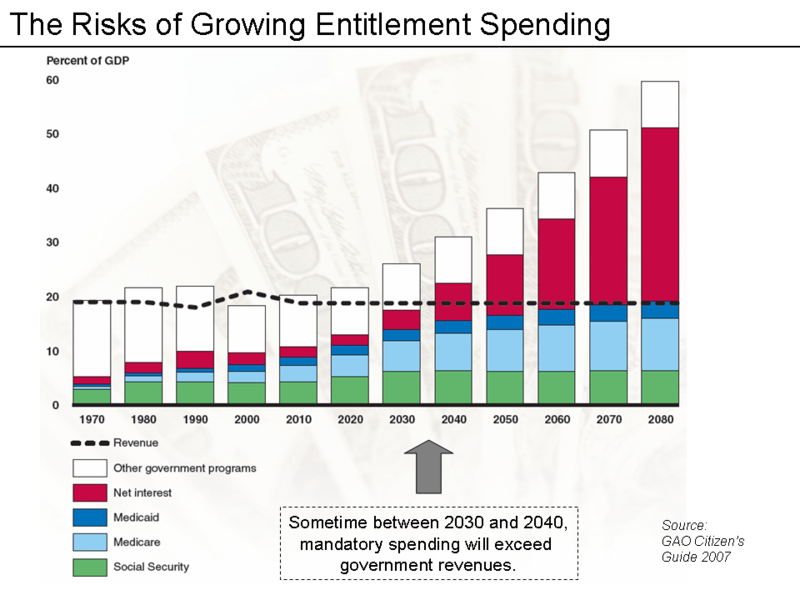
And unfortunately, the problem is only going to get far, far worse when you project things out beyond the year 2020. Right now, interest on the debt and spending on entitlement programs like Social Security and Medicare eat up only about 10 percent of GDP. By 2080, they are projected to eat up approximately 50 percent of GDP. In fact, things are even more dire than the chart below indicates. This chart is based on previous government figures that projected that mandatory spending will exceed government revenues at some point between 2030 and 2040, but the latest government figures now project that this will happen right around 2020. So as mind blowing as this chart is, keep in mind that it actually understates the problem we are facing...
Now it is happening in 2010.
It turns out that the "recession" that we have just been through has hit Social Security revenues really hard.
And unfortunately, as waves of Baby Boomers start retiring, these "Social Security deficits" are going to get even worse.
So where will the money come from to pay the benefits that are owed?
For now, the money will come from the $2.5 trillion Social Security Trust Fund that has been accumulated.
But keep in mind that the $2.5 trillion figure is extremely misleading.
There are not $2.5 trillion dollars sitting around in a bank account somewhere to pay these benefits.
The truth is that the Social Security Trust Fund does not contain any actual assets.
The only assets the Social Security Trust Fund has are IOUs from the U.S. government.
So basically the U.S. government owes the Social Security Trust Fund $2.5 trillion dollars, and now it turns out that the Social Security system is going to start needing that money.
So where will the U.S. government get that money?
Well, they will borrow it of course.
The reality is that the Social Security program is simply not sustainable.
Back in 1950 each retiree's Social Security benefit was paid for by 16 workers.
Today, each retiree's Social Security benefit is paid for by approximately 3.3 workers. By 2025 it is projected that there will be about two workers for each retiree.
As a society, we simply have not been producing enough new workers to sustain the current system.
Of course the politicians all say the right things to make us think that they are going to do something about this crisis. For example, Barack Obama recently had the following to say about the massive deficits the U.S. government keeps piling up: "It keeps me awake at night, looking at all that red ink".
But the truth is that neither political party would dare propose a dramatic restructuring of
Social Security or Medicare that would significantly reduce benefits.
Why?
Because it would be political suicide.
Say what you want about old people - the truth is that they vote more than the rest of us do.
Anyone who would dare "take away" their Social Security or Medicare would suddenly find hordes of old people voting against them in the next election.
But something has to be done.
The 2009 Financial Report of the U.S. Government was recently released, and it basically says that the U.S. government is facing financial Armageddon if something drastic is not done....
Absent a change in policy, under this scenario, the interest costs on the growing debt together with spending on major entitlement programs could absorb 92 cents of every dollar of federal revenue in 2019.
Keep in mind that this is before anything is spent on defense, health care, education, homeland security, job creation or anything else.
The following chart was pulled right out of the report. These aren't the projections of some Internet wacko. These projections are in an official U.S. government report. The implications of the chart below are absolutely mind blowing...
Keep in mind that the U.S. government and the U.S. economy are already on the verge of financial oblivion in 2010. So what is going to happen if these projections are anywhere close to accurate?
In addition, the report also admitted that the present value of projected scheduled benefits exceeds earmarked revenues for entitlement programs such as Social Security and Medicare by about $46 trillion over the next 75 years.
$46 trillion!
Either the U.S. government is going to have to radically slash Social Security and Medicare benefits or they will have to come up with tens of trillions of extra dollars from somewhere.
And remember, the $46 trillion figure is just the "present value" of those future payments.
Because of inflation, the "actual value" of those future payments will be far greater.
In a section about Social Security and Medicare, the authors of the report confessed that "it is apparent that these programs are on a fiscally unsustainable path".
Obviously something has got to give.
These programs cannot keep on paying the same level of benefits.
It is financially impossible.
But what are we going to do? Millions upon millions of elderly Americans rely on these programs.
Are we going to reduce payments to a level where they can only afford dog food to eat and a shack to live in?
As a society, we are really between a rock and hard place.
If we continue on the same path, the United States government is going to go bankrupt.
But any politician who tries to cut benefits or raise taxes will likely face the wrath of the voters at the ballot box.
So for now the U.S. government just continues to spend even more money and continues to go into increasing amounts of debt - apparently hoping that somehow everything will just turn out okay.
But things are not going to turn out okay. We are headed for a financial mess of horrifying proportions.
The truth is that it doesn't matter how much the U.S. government cuts spending in other areas if it does not get entitlement spending and interest on the national debt under control. If those expenditures are not addressed, it is absolutely guaranteed that the U.S. government will be swamped in red ink for many years to come.
But until severe financial pain starts happening, a large percentage of the American people are not going to be motivated to do anything about this problem.
But by then it will be too late.
There is a silent monster that looms menacingly over U.S. government finances. Every politician knows about it, but very few of them ever want to talk about it. This silent monster grows larger every year, and yet nobody seems to know quite what to do about it. Those who have closely analyzed this monster all seem to agree that one day it will create a financial tsunami of a magnitude that is absolutely unprecedented, but there is vast disagreement about how to escape this financial tsunami or if it is even possible to escape it. The name of this monster is "entitlements" - Social Security, Medicare and other social Ponzi schemes that the U.S. government has locked itself into funding. It would be hard to understate the seriousness of the problem that entitlements present. In fact, according to an official U.S. government report, rapidly growing interest costs on the national debt together with spending on major entitlement programs will absorb approximately 92 cents of every dollar of federal revenue by the year 2019. By 2020, that figure will be up around 100 cents of every dollar of federal revenue. So that means that interest on the debt and spending on entitlement programs will eat up everything the U.S. government takes in before a penny is spent on anything else. That is a recipe for national financial suicide.
And unfortunately, the problem is only going to get far, far worse when you project things out beyond the year 2020. Right now, interest on the debt and spending on entitlement programs like Social Security and Medicare eat up only about 10 percent of GDP. By 2080, they are projected to eat up approximately 50 percent of GDP. In fact, things are even more dire than the chart below indicates. This chart is based on previous government figures that projected that mandatory spending will exceed government revenues at some point between 2030 and 2040, but the latest government figures now project that this will happen right around 2020. So as mind blowing as this chart is, keep in mind that it actually understates the problem we are facing...
Now it is happening in 2010.
It turns out that the "recession" that we have just been through has hit Social Security revenues really hard.
And unfortunately, as waves of Baby Boomers start retiring, these "Social Security deficits" are going to get even worse.
So where will the money come from to pay the benefits that are owed?
For now, the money will come from the $2.5 trillion Social Security Trust Fund that has been accumulated.
But keep in mind that the $2.5 trillion figure is extremely misleading.
There are not $2.5 trillion dollars sitting around in a bank account somewhere to pay these benefits.
The truth is that the Social Security Trust Fund does not contain any actual assets.
The only assets the Social Security Trust Fund has are IOUs from the U.S. government.
So basically the U.S. government owes the Social Security Trust Fund $2.5 trillion dollars, and now it turns out that the Social Security system is going to start needing that money.
So where will the U.S. government get that money?
Well, they will borrow it of course.
The reality is that the Social Security program is simply not sustainable.
Back in 1950 each retiree's Social Security benefit was paid for by 16 workers.
Today, each retiree's Social Security benefit is paid for by approximately 3.3 workers. By 2025 it is projected that there will be about two workers for each retiree.
As a society, we simply have not been producing enough new workers to sustain the current system.
Of course the politicians all say the right things to make us think that they are going to do something about this crisis. For example, Barack Obama recently had the following to say about the massive deficits the U.S. government keeps piling up: "It keeps me awake at night, looking at all that red ink".
But the truth is that neither political party would dare propose a dramatic restructuring of
Social Security or Medicare that would significantly reduce benefits.
Why?
Because it would be political suicide.
Say what you want about old people - the truth is that they vote more than the rest of us do.
Anyone who would dare "take away" their Social Security or Medicare would suddenly find hordes of old people voting against them in the next election.
But something has to be done.
The 2009 Financial Report of the U.S. Government was recently released, and it basically says that the U.S. government is facing financial Armageddon if something drastic is not done....
Absent a change in policy, under this scenario, the interest costs on the growing debt together with spending on major entitlement programs could absorb 92 cents of every dollar of federal revenue in 2019.
Keep in mind that this is before anything is spent on defense, health care, education, homeland security, job creation or anything else.
The following chart was pulled right out of the report. These aren't the projections of some Internet wacko. These projections are in an official U.S. government report. The implications of the chart below are absolutely mind blowing...
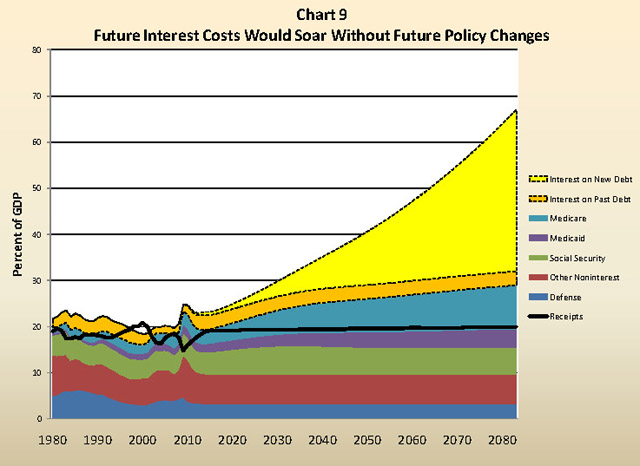
Keep in mind that the U.S. government and the U.S. economy are already on the verge of financial oblivion in 2010. So what is going to happen if these projections are anywhere close to accurate?
In addition, the report also admitted that the present value of projected scheduled benefits exceeds earmarked revenues for entitlement programs such as Social Security and Medicare by about $46 trillion over the next 75 years.
$46 trillion!
Either the U.S. government is going to have to radically slash Social Security and Medicare benefits or they will have to come up with tens of trillions of extra dollars from somewhere.
And remember, the $46 trillion figure is just the "present value" of those future payments.
Because of inflation, the "actual value" of those future payments will be far greater.
In a section about Social Security and Medicare, the authors of the report confessed that "it is apparent that these programs are on a fiscally unsustainable path".
Obviously something has got to give.
These programs cannot keep on paying the same level of benefits.
It is financially impossible.
But what are we going to do? Millions upon millions of elderly Americans rely on these programs.
Are we going to reduce payments to a level where they can only afford dog food to eat and a shack to live in?
As a society, we are really between a rock and hard place.
If we continue on the same path, the United States government is going to go bankrupt.
But any politician who tries to cut benefits or raise taxes will likely face the wrath of the voters at the ballot box.
So for now the U.S. government just continues to spend even more money and continues to go into increasing amounts of debt - apparently hoping that somehow everything will just turn out okay.
But things are not going to turn out okay. We are headed for a financial mess of horrifying proportions.
The truth is that it doesn't matter how much the U.S. government cuts spending in other areas if it does not get entitlement spending and interest on the national debt under control. If those expenditures are not addressed, it is absolutely guaranteed that the U.S. government will be swamped in red ink for many years to come.
But until severe financial pain starts happening, a large percentage of the American people are not going to be motivated to do anything about this problem.
But by then it will be too late.
China - Not Yet a Superpower
China is taking advantage of the credit crisis and president Obama's percieved weakness, to promote themselves as the new world super power. China is not in a position to take over, or even share the stage; not yet at least. I could elaborate on this, but I think Ambrose Evans-Pritchard states it better than I could:
China has succumbed to hubris. It has mistaken the soft diplomacy of Barack Obama for weakness, mistaken the US credit crisis for decline, and mistaken its own mercantilist bubble for ascendancy. There are echoes of Anglo-German spats before the First World War, when Wilhelmine Berlin so badly misjudged the strategic balance of power and over-played its hand.
(...)
Is the Politiburo smoking weed?
I let others discuss the rights and wrongs of this, itself a response to the US report card on China. Clearly, Beijing is in denial about is own part in the global imbalances behind the credit crisis, specifically by running structural trade surpluses, and driving down long rates through dollar and euro bond purchases. No doubt the West has made a hash of things, but the Chinese view of events is twisted to the point of delusional.
What interests me is Beijing's willingness to up the ante. It has vowed sanctions against any US firm that takes part in a $6.4bn weapons contract for Taiwan, a threat to ban Boeing from China and a new level of escalation in the Taiwan dispute.
In Copenhagen, Wen Jiabao sent an underling to negotiate with Mr Obama in what was intended to be - and taken to be - a humiliation. The US President put his foot down, saying: "I don't want to mess around with this anymore." That sums up White House feelings towards China today.
We have talked ourselves into believing that China is already a hyper-power. It may become one: it is not one yet. China is ringed by states - Japan, Korea, Vietnam, India - that are American allies when push comes to shove. It faces a prickly Russia on its 4,000km border, where Chinese migrants are itching for Lebensraum across the Amur. Emerging Asia, Brazil, Egypt and Europe are all irked by China's yuan-rigged export dumping.
Michael Pettis from Beijing University argues that China's reserves of $2.4 trillion - arguably $3 trillion - are a sign of weakness, not strength. Only twice before in modern history has a country amassed such a stash equal to 5pc-6pc of global GDP: the US in the 1920s, and Japan in the 1980s. Each time preceeded depression.
The reserves cannot be used internally to support China's economy. They are dead weight, beyond any level needed for macro-credibility. Indeed, they are the ultimate indictment of China's dysfunctional strategy, which is to buy $30bn to $40bn of foreign bonds every month to hold down the yuan, refusing to let the economy adjust to trade realities. The result is over-investment in plant, flooding the world with goods at wafer-thin export margins. China's over-capacity in steel is now greater than Europe's output.
This is catching up with China, in any case. Professor Victor Shuh from Northerwestern University warns that the 8,000 financing vehicles used by China's local governments to stretch credit limits have built up debts and commitments of $3.5 trillion, mostly linked to infrastructure. He says the banks may require a bail-out nearing half a trillion dollars.
As America's creditor - owner of some $1.4 trillion of US Treasuries, agency bonds, and US instruments - China can exert leverage. But this is not what it seems. If the Politburo deploys its illusiory power, Washington can pull the plug on China's export economy instantly by shutting markets. Who holds whom to ransom?
Any attempt to retaliate by triggering a US bond crisis would rebound against China, and could be stopped - in extremis - by capital controls. Roosevelt changed the rules in 1933. Such things happen. The China-US relationship is no doubt symbiotic, but a clash would not be "mutual assured destruction", as often claimed. Washington would win.
China has succumbed to hubris. It has mistaken the soft diplomacy of Barack Obama for weakness, mistaken the US credit crisis for decline, and mistaken its own mercantilist bubble for ascendancy. There are echoes of Anglo-German spats before the First World War, when Wilhelmine Berlin so badly misjudged the strategic balance of power and over-played its hand.
(...)
Is the Politiburo smoking weed?
I let others discuss the rights and wrongs of this, itself a response to the US report card on China. Clearly, Beijing is in denial about is own part in the global imbalances behind the credit crisis, specifically by running structural trade surpluses, and driving down long rates through dollar and euro bond purchases. No doubt the West has made a hash of things, but the Chinese view of events is twisted to the point of delusional.
What interests me is Beijing's willingness to up the ante. It has vowed sanctions against any US firm that takes part in a $6.4bn weapons contract for Taiwan, a threat to ban Boeing from China and a new level of escalation in the Taiwan dispute.
In Copenhagen, Wen Jiabao sent an underling to negotiate with Mr Obama in what was intended to be - and taken to be - a humiliation. The US President put his foot down, saying: "I don't want to mess around with this anymore." That sums up White House feelings towards China today.
We have talked ourselves into believing that China is already a hyper-power. It may become one: it is not one yet. China is ringed by states - Japan, Korea, Vietnam, India - that are American allies when push comes to shove. It faces a prickly Russia on its 4,000km border, where Chinese migrants are itching for Lebensraum across the Amur. Emerging Asia, Brazil, Egypt and Europe are all irked by China's yuan-rigged export dumping.
Michael Pettis from Beijing University argues that China's reserves of $2.4 trillion - arguably $3 trillion - are a sign of weakness, not strength. Only twice before in modern history has a country amassed such a stash equal to 5pc-6pc of global GDP: the US in the 1920s, and Japan in the 1980s. Each time preceeded depression.
The reserves cannot be used internally to support China's economy. They are dead weight, beyond any level needed for macro-credibility. Indeed, they are the ultimate indictment of China's dysfunctional strategy, which is to buy $30bn to $40bn of foreign bonds every month to hold down the yuan, refusing to let the economy adjust to trade realities. The result is over-investment in plant, flooding the world with goods at wafer-thin export margins. China's over-capacity in steel is now greater than Europe's output.
This is catching up with China, in any case. Professor Victor Shuh from Northerwestern University warns that the 8,000 financing vehicles used by China's local governments to stretch credit limits have built up debts and commitments of $3.5 trillion, mostly linked to infrastructure. He says the banks may require a bail-out nearing half a trillion dollars.
As America's creditor - owner of some $1.4 trillion of US Treasuries, agency bonds, and US instruments - China can exert leverage. But this is not what it seems. If the Politburo deploys its illusiory power, Washington can pull the plug on China's export economy instantly by shutting markets. Who holds whom to ransom?
Any attempt to retaliate by triggering a US bond crisis would rebound against China, and could be stopped - in extremis - by capital controls. Roosevelt changed the rules in 1933. Such things happen. The China-US relationship is no doubt symbiotic, but a clash would not be "mutual assured destruction", as often claimed. Washington would win.
Green Job Fail - Wind Farms Fail to Bring Jobs
"Despite all the talk of green jobs, the overwhelming majority of stimulus money spent on wind power has gone to foreign companies, according to a new report by the Investigative Reporting Workshop at the American University's School of Communication in Washington, D.C. Even with the infusion of so much stimulus money, a recent report by American Wind Energy Association showed a drop in U.S. wind manufacturing jobs last year."
Shocker.
Via
It Is Now Mathematically Impossible To Pay Off The U.S. National Debt
It Is Now Mathematically Impossible To Pay Off The U.S. National Debt
A lot of people are very upset about the rapidly increasing U.S. national debt these days and they are demanding a solution. What they don't realize is that there simply is not a solution under the current U.S. financial system. It is now mathematically impossible for the U.S. government to pay off the U.S. national debt. You see, the truth is that the U.S. government now owes more dollars than actually exist. If the U.S. government went out today and took every single penny from every single American bank, business and taxpayer, they still would not be able to pay off the national debt. And if they did that, obviously American society would stop functioning because nobody would have any money to buy or sell anything.
And the U.S. government would still be massively in debt.
So why doesn't the U.S. government just fire up the printing presses and print a bunch of money to pay off the debt?
Well, for one very simple reason.
That is not the way our system works.
You see, for more dollars to enter the system, the U.S. government has to go into more debt.
The U.S. government does not issue U.S. currency - the Federal Reserve does.
The Federal Reserve is a private bank owned and operated for profit by a very powerful group of elite international bankers.
If you will pull a dollar bill out and take a look at it, you will notice that it says "Federal Reserve Note" at the top.
It belongs to the Federal Reserve.
The U.S. government cannot simply go out and create new money whenever it wants under our current system.
Instead, it must get it from the Federal Reserve.
So, when the U.S. government needs to borrow more money (which happens a lot these days) it goes over to the Federal Reserve and asks them for some more green pieces of paper called Federal Reserve Notes.
The Federal Reserve swaps these green pieces of paper for pink pieces of paper called U.S. Treasury bonds. The Federal Reserve either sells these U.S. Treasury bonds or they keep the bonds for themselves (which happens a lot these days).
So that is how the U.S. government gets more green pieces of paper called "U.S. dollars" to put into circulation. But by doing so, they get themselves into even more debt which they will owe even more interest on.
So every time the U.S. government does this, the national debt gets even bigger and the interest on that debt gets even bigger.
Are you starting to get the picture?
As you read this, the U.S. national debt is approximately 12 trillion dollars, although it is going up so rapidly that it is really hard to pin down an exact figure.
So how much money actually exists in the United States today?
Well, there are several ways to measure this.
The "M0" money supply is the total of all physical bills and currency, plus the money on hand in bank vaults and all of the deposits those banks have at reserve banks. As of mid-2009, the Federal Reserve said that this amount was about 908 billion dollars.
The "M1" money supply includes all of the currency in the "M0" money supply, along with all of the money held in checking accounts and other checkable accounts at banks, as well as all money contained in travelers' checks. According to the Federal Reserve, this totaled approximately 1.7 trillion dollars in December 2009, but not all of this money actually "exists" as we will see in a moment.
The "M2" money supply includes everything in the "M1" money supply plus most other savings accounts, money market accounts, retail money market mutual funds, and small denomination time deposits (certificates of deposit of under $100,000). According to the Federal Reserve, this totaled approximately 8.5 trillion dollars in December 2009, but once again, not all of this money actually "exists" as we will see in a moment.
The "M3" money supply includes everything in the "M2" money supply plus all other CDs (large time deposits and institutional money market mutual fund balances), deposits of eurodollars and repurchase agreements. The Federal Reserve does not keep track of M3 anymore, but according to ShadowStats.com it is currently somewhere in the neighborhood of 14 trillion dollars. But again, not all of this "money" actually "exists" either.
So why doesn't it exist?
It is because our financial system is based on something called fractional reserve banking.
When you go over to your local bank and deposit $100, they do not keep your $100 in the bank. Instead, they keep only a small fraction of your money there at the bank and they lend out the rest to someone else. Then, if that person deposits the money that was just borrowed at the same bank, that bank can loan out most of that money once again. In this way, the amount of "money" quickly gets multiplied. But in reality, only $100 actually exists. The system works because we do not all run down to the bank and demand all of our money at the same time.
According to the New York Federal Reserve Bank, fractional reserve banking can be explained this way.
"If the reserve requirement is 10%, for example, a bank that receives a $100 deposit may lend out $90 of that deposit. If the borrower then writes a check to someone who deposits the $90, the bank receiving that deposit can lend out $81. As the process continues, the banking system can expand the initial deposit of $100 into a maximum of $1,000 of money ($100+$90+81+$72.90+...=$1,000)."
So much of the "money" out there today is basically made up out of thin air.
In fact, most banks have no reserve requirements at all on savings deposits, CDs and certain kinds of money market accounts. Primarily, reserve requirements apply only to "transactions deposits" – essentially checking accounts.
The truth is that banks are freer today to dramatically "multiply" the amounts deposited with them than ever before. But all of this "multiplied" money is only on paper - it doesn't actually exist.
The point is that the broadest measures of the money supply (M2 and M3) vastly overstate how much "real money" actually exists in the system.
So if the U.S. government went out today and demanded every single dollar from all banks, businesses and individuals in the United States it would not be able to collect 14 trillion dollars (M3) or even 8.5 trillion dollars (M2) because those amounts are based on fractional reserve banking.
So the bottom line is this:
#1) If all money owned by all American banks, businesses and individuals was gathered up today and sent to the U.S. government, there would not be enough to pay off the U.S. national debt.
#2) The only way to create more money is to go into even more debt which makes the problem even worse.
You see, this is what the whole Federal Reserve System was designed to do. It was designed to slowly drain the massive wealth of the American people and transfer it to the elite international bankers.
It is a game that is designed so that the U.S. government cannot win. As soon as they create more money by borrowing it, the U.S. government owes more than what was created because of interest.
If you owe more money than ever was created you can never pay it back.
That means perpetual debt for as long as the system exists.
It is a system designed to force the U.S. government into ever-increasing amounts of debt because there is no escape.
Of course if we had listened to our very wise founding father Thomas Jefferson, we could have avoided this colossal mess in the first place.
"If the American people ever allow private banks to control the issue of their money, first by inflation and then by deflation, the banks and corporations that will grow up around them (around the banks), will deprive the people of their property until their children will wake up homeless on the continent their fathers conquered."
But we didn't listen, did we?
We could solve this problem by shutting down the Federal Reserve and restoring the power to issue U.S. currency to the U.S. Congress (which is what the U.S. Constitution calls for). But the politicians in Washington D.C. are not about to do that.
So unless you are willing to fundamentally change the current system, you might as well quit complaining about the U.S. national debt because it is now mathematically impossible to pay it off.
A lot of people are very upset about the rapidly increasing U.S. national debt these days and they are demanding a solution. What they don't realize is that there simply is not a solution under the current U.S. financial system. It is now mathematically impossible for the U.S. government to pay off the U.S. national debt. You see, the truth is that the U.S. government now owes more dollars than actually exist. If the U.S. government went out today and took every single penny from every single American bank, business and taxpayer, they still would not be able to pay off the national debt. And if they did that, obviously American society would stop functioning because nobody would have any money to buy or sell anything.
And the U.S. government would still be massively in debt.
So why doesn't the U.S. government just fire up the printing presses and print a bunch of money to pay off the debt?
Well, for one very simple reason.
That is not the way our system works.
You see, for more dollars to enter the system, the U.S. government has to go into more debt.
The U.S. government does not issue U.S. currency - the Federal Reserve does.
The Federal Reserve is a private bank owned and operated for profit by a very powerful group of elite international bankers.
If you will pull a dollar bill out and take a look at it, you will notice that it says "Federal Reserve Note" at the top.
It belongs to the Federal Reserve.
The U.S. government cannot simply go out and create new money whenever it wants under our current system.
Instead, it must get it from the Federal Reserve.
So, when the U.S. government needs to borrow more money (which happens a lot these days) it goes over to the Federal Reserve and asks them for some more green pieces of paper called Federal Reserve Notes.
The Federal Reserve swaps these green pieces of paper for pink pieces of paper called U.S. Treasury bonds. The Federal Reserve either sells these U.S. Treasury bonds or they keep the bonds for themselves (which happens a lot these days).
So that is how the U.S. government gets more green pieces of paper called "U.S. dollars" to put into circulation. But by doing so, they get themselves into even more debt which they will owe even more interest on.
So every time the U.S. government does this, the national debt gets even bigger and the interest on that debt gets even bigger.
Are you starting to get the picture?
As you read this, the U.S. national debt is approximately 12 trillion dollars, although it is going up so rapidly that it is really hard to pin down an exact figure.
So how much money actually exists in the United States today?
Well, there are several ways to measure this.
The "M0" money supply is the total of all physical bills and currency, plus the money on hand in bank vaults and all of the deposits those banks have at reserve banks. As of mid-2009, the Federal Reserve said that this amount was about 908 billion dollars.
The "M1" money supply includes all of the currency in the "M0" money supply, along with all of the money held in checking accounts and other checkable accounts at banks, as well as all money contained in travelers' checks. According to the Federal Reserve, this totaled approximately 1.7 trillion dollars in December 2009, but not all of this money actually "exists" as we will see in a moment.
The "M2" money supply includes everything in the "M1" money supply plus most other savings accounts, money market accounts, retail money market mutual funds, and small denomination time deposits (certificates of deposit of under $100,000). According to the Federal Reserve, this totaled approximately 8.5 trillion dollars in December 2009, but once again, not all of this money actually "exists" as we will see in a moment.
The "M3" money supply includes everything in the "M2" money supply plus all other CDs (large time deposits and institutional money market mutual fund balances), deposits of eurodollars and repurchase agreements. The Federal Reserve does not keep track of M3 anymore, but according to ShadowStats.com it is currently somewhere in the neighborhood of 14 trillion dollars. But again, not all of this "money" actually "exists" either.
So why doesn't it exist?
It is because our financial system is based on something called fractional reserve banking.
When you go over to your local bank and deposit $100, they do not keep your $100 in the bank. Instead, they keep only a small fraction of your money there at the bank and they lend out the rest to someone else. Then, if that person deposits the money that was just borrowed at the same bank, that bank can loan out most of that money once again. In this way, the amount of "money" quickly gets multiplied. But in reality, only $100 actually exists. The system works because we do not all run down to the bank and demand all of our money at the same time.
According to the New York Federal Reserve Bank, fractional reserve banking can be explained this way.
"If the reserve requirement is 10%, for example, a bank that receives a $100 deposit may lend out $90 of that deposit. If the borrower then writes a check to someone who deposits the $90, the bank receiving that deposit can lend out $81. As the process continues, the banking system can expand the initial deposit of $100 into a maximum of $1,000 of money ($100+$90+81+$72.90+...=$1,000)."
So much of the "money" out there today is basically made up out of thin air.
In fact, most banks have no reserve requirements at all on savings deposits, CDs and certain kinds of money market accounts. Primarily, reserve requirements apply only to "transactions deposits" – essentially checking accounts.
The truth is that banks are freer today to dramatically "multiply" the amounts deposited with them than ever before. But all of this "multiplied" money is only on paper - it doesn't actually exist.
The point is that the broadest measures of the money supply (M2 and M3) vastly overstate how much "real money" actually exists in the system.
So if the U.S. government went out today and demanded every single dollar from all banks, businesses and individuals in the United States it would not be able to collect 14 trillion dollars (M3) or even 8.5 trillion dollars (M2) because those amounts are based on fractional reserve banking.
So the bottom line is this:
#1) If all money owned by all American banks, businesses and individuals was gathered up today and sent to the U.S. government, there would not be enough to pay off the U.S. national debt.
#2) The only way to create more money is to go into even more debt which makes the problem even worse.
You see, this is what the whole Federal Reserve System was designed to do. It was designed to slowly drain the massive wealth of the American people and transfer it to the elite international bankers.
It is a game that is designed so that the U.S. government cannot win. As soon as they create more money by borrowing it, the U.S. government owes more than what was created because of interest.
If you owe more money than ever was created you can never pay it back.
That means perpetual debt for as long as the system exists.
It is a system designed to force the U.S. government into ever-increasing amounts of debt because there is no escape.
Of course if we had listened to our very wise founding father Thomas Jefferson, we could have avoided this colossal mess in the first place.
"If the American people ever allow private banks to control the issue of their money, first by inflation and then by deflation, the banks and corporations that will grow up around them (around the banks), will deprive the people of their property until their children will wake up homeless on the continent their fathers conquered."
But we didn't listen, did we?
We could solve this problem by shutting down the Federal Reserve and restoring the power to issue U.S. currency to the U.S. Congress (which is what the U.S. Constitution calls for). But the politicians in Washington D.C. are not about to do that.
So unless you are willing to fundamentally change the current system, you might as well quit complaining about the U.S. national debt because it is now mathematically impossible to pay it off.

